
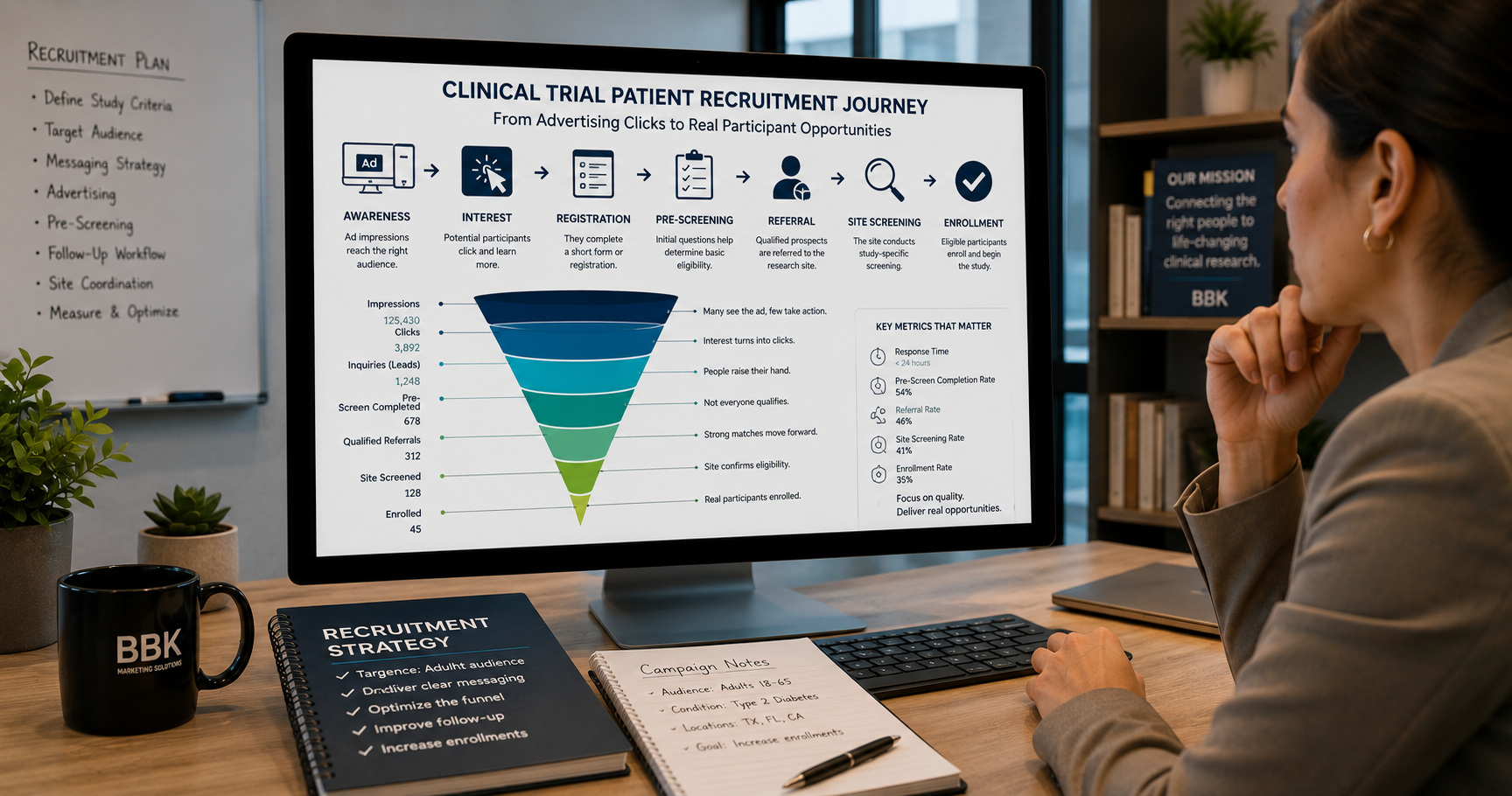
A clinical trial recruitment campaign can generate hundreds of clicks and still fail to solve a Research Site’s enrollment problem.
That may sound contradictory, but it highlights one of the most important distinctions in clinical research marketing:
Advertising response is not the same thing as participant recruitment.
A person clicking an advertisement represents interest. A completed contact form represents an inquiry. Neither automatically represents a participant who is appropriate for the Study, willing to move forward, able to reach the Research Site, or ultimately eligible under the protocol.
Successful clinical trial patient recruitment therefore requires a system capable of moving people through several stages — from initial awareness to a meaningful opportunity for the Research Site. Understanding that journey changes how recruitment campaigns should be designed, managed, and measured.
The Click Is Only the Beginning
Digital platforms make the first stage of recruitment relatively easy to measure. Marketing teams can track impressions, reach, video views, clicks, landing-page visits, completed forms, and Cost Per Lead.
These metrics matter. They help determine whether advertising is reaching people efficiently and whether the message generates enough interest for someone to respond.
But the Research Site ultimately needs something different. It needs potential participants who can progress through the recruitment process.
The real recruitment journey may look more like:
Ad Impression → Click → Registration → Initial Contact → Preliminary Pre-Screening → Potential Referral → Site Screening → Enrollment
Every stage creates attrition. That is normal. The objective is not to eliminate every point of drop-off. It is to understand where it occurs, why it occurs, and whether the marketing and recruitment system is producing enough appropriate opportunities for the Study.
A Lead and a Participant Opportunity Are Different Things
In conventional digital marketing, a lead often represents a successful conversion. Someone requests a quote, schedules a consultation, submits an inquiry, or provides contact information.
Clinical research is different. Someone may respond to a Study advertisement because the condition mentioned seems relevant, a family member may qualify, they want more information, they are curious about compensation, they misunderstood part of the advertisement, they live too far from the Research Site, they do not meet a major eligibility criterion, or they simply want to know what participation involves.
None of these responses is inherently a marketing failure. Recruitment advertising is designed to create interest among people who could potentially be relevant. But calling every response a qualified participant creates the wrong expectation.
A better approach is to recognize several levels of value.
Inquiry
A person has responded and provided sufficient information to initiate communication.
Preliminary Pre-Screened Opportunity
Initial information suggests that the person may meet certain basic recruitment criteria.
Referral
The information has progressed far enough that it can appropriately be routed to the Research Site for further evaluation.
Site Screening
The Site performs the study-specific procedures necessary to determine eligibility.
Enrollment
An eligible individual completes the required enrollment process according to the Study protocol.
These stages should not be treated as interchangeable.
Preliminary Pre-Screening Creates an Important Bridge
One of the most useful stages between digital advertising and Research Site screening is preliminary pre-screening. This stage can help determine whether an inquiry appears relevant before Site personnel dedicate substantial time to it.
For example, depending on the Study and approved recruitment process, initial questions may address factors such as age range, diagnosed condition, general geographic location, certain broad Study-specific criteria, or willingness to be contacted for additional information.
Pre-screening is not the same as determining clinical eligibility. Final eligibility belongs within the appropriate research process and must follow the Study protocol. The role of preliminary recruitment screening is narrower: helping organize inquiries and identify which people may reasonably justify further contact.
This distinction is important both operationally and ethically. FDA recruitment guidance specifically recognizes that initial contact may involve scripts used to determine basic eligibility and notes that procedures for handling personal and potentially sensitive information require appropriate safeguards.
In practical terms, this means that a recruitment system needs to think not only about what questions are asked, but also why they are being asked, who receives the answers, how information is handled, what happens when someone does not appear eligible, and what the prospective participant has been told about the process.
Recruitment Starts Before the Advertisement Goes Live
Poor recruitment performance is often treated as an advertising problem after the campaign begins. Sometimes the real problem occurred before the first impression was ever delivered.
NIH/NIMH recruitment guidance encourages investigators to consider recruitment barriers, target populations, study materials, staff preparation, realistic site capacity, language needs, screening stages, and retention strategy during study planning.
From a marketing perspective, that means recruitment planning should answer several questions before media spend begins.
Who Are We Trying to Reach?
The target audience cannot simply be defined as “people interested in clinical trials.” The Study may require a particular age group, condition, geographic area, caregiver relationship, language, or other protocol-relevant characteristic. Marketing strategy should translate those requirements into an audience that advertising platforms can realistically reach without making inappropriate assumptions about individual eligibility.
Where Must Participants Be Located?
A person may appear appropriate but live too far away to participate realistically. Geography therefore affects both advertising strategy and referral quality.
What Is the Recruitment Message?
The advertisement needs to generate interest while accurately describing the research opportunity. FDA guidance considers direct recruitment advertising part of the subject-selection and informed-consent process and expects IRBs to review recruitment methods and materials within the scope of applicable regulations. That limits the usefulness of conventional advertising tactics built around exaggeration, urgency, guaranteed outcomes, or aggressive claims.
What Happens After Someone Responds?
This is the question recruitment teams often underestimate. If the answer is simply “the lead goes into an email inbox and someone calls later,” the organization may have an advertising campaign but not yet have a recruitment system.
Response Time Can Change the Value of a Lead
Imagine a prospective participant sees an advertisement at 8:45 p.m. They complete the form because the Study seems relevant. At that moment, motivation is relatively high.
Now imagine nothing happens until two days later. By then, they may forget which Study they responded to, assume nobody received the form, become uncomfortable about participating, respond to another recruitment opportunity, ignore an unfamiliar phone number, or simply lose interest.
The advertisement technically converted. The recruitment process did not.
This is why communication workflows can influence marketing performance. An immediate acknowledgment does not need to determine eligibility or provide medical advice. It can simply confirm that the inquiry was received, explain what happens next, and establish expectations for future contact.
The broader NIH recruitment resources similarly emphasize thoughtful communication with potential participants and ongoing attention to people who appear potentially eligible but have not yet progressed through the research process.
Research Sites Need to Understand Their Own Capacity
More leads are not always better.
Suppose a Site can realistically handle 20 new participant conversations each day. A campaign suddenly produces 80. From the advertising dashboard, performance may look excellent. Operationally, the Site has a problem.
If staff cannot respond efficiently, those additional inquiries may create longer response times, incomplete follow-up, duplicated outreach, poor documentation, frustrated prospective participants, and lower conversion deeper in the recruitment funnel.
NIMH specifically recommends considering the maximum number of participants a Site can screen, enroll, and follow simultaneously when planning multi-site clinical research.
Marketing therefore needs to consider operational capacity. An effective recruitment campaign does not simply create the maximum possible demand. It creates manageable, relevant recruitment opportunities that the organization can process effectively.
Why Cost Per Lead Can Be Misleading
Consider two hypothetical campaigns.
Campaign A — 300 inquiries, $20 Cost Per Lead, 40 preliminary pre-screened opportunities, 15 Site referrals.
Campaign B — 180 inquiries, $28 Cost Per Lead, 70 preliminary pre-screened opportunities, 40 Site referrals.
If the marketing team evaluates only CPL, Campaign A appears superior. But the Research Site may strongly prefer Campaign B. The purpose of this example is not to establish an industry benchmark — the figures are illustrative. It demonstrates why recruitment economics should be measured at several stages.
A useful reporting structure might include:
Advertising Spend → Cost Per Inquiry → Pre-Screen Completion Rate → Cost Per Preliminary Qualified Opportunity → Referral Rate → Cost Per Referral → Site Screening Rate → Enrollment
As data matures, the organization can begin identifying exactly where recruitment performance is being gained or lost.
Campaign Optimization Should Follow the Funnel
Once the full process is measured, campaign decisions become more intelligent.
High Click Rate + Low Form Completion. Possible issue: the advertisement creates interest, but the registration process introduces too much friction or does not match expectations.
High Lead Volume + Low Preliminary Qualification. Possible issue: audience targeting or recruitment messaging may be too broad.
Good Preliminary Qualification + Low Contact Rate. Possible issue: the problem may be follow-up rather than advertising.
Strong Referral Volume + Weak Site Screening. Possible issue: recruitment criteria, Site workflow, referral quality, or protocol-related factors require closer analysis.
Strong Screening + Weak Enrollment. At that point, the issue may no longer be primarily a marketing problem.
This illustrates why a recruitment dashboard should not stop at advertising metrics. The closer marketing teams can connect campaign activity with downstream recruitment outcomes, the better they can allocate resources.
The Participant Experience Is Part of the Funnel
Recruitment metrics describe what happens. Participant experience can help explain why it happens.
From the prospective participant’s perspective, the journey may include seeing an unfamiliar Study advertisement, deciding whether it appears trustworthy, reading information about the opportunity, providing personal contact information, answering preliminary questions, waiting for communication, speaking with recruitment personnel, deciding whether to continue, and interacting with the Research Site.
Every stage creates an opportunity either to build confidence or create uncertainty. That means small operational details can matter: clear language, mobile-friendly forms, realistic expectations, appropriate confirmation messages, language accessibility, identifiable communication, reasonable response times, and clear explanation of the next step.
NIH recruitment guidance emphasizes designing materials for the intended audience, using clear language, considering the first language of target populations, and matching recruitment methods to the people the Study intends to reach. These are not merely communication preferences. They can affect recruitment performance.
The Goal Is Not More Leads. It Is Better Recruitment.
Clinical trial recruitment marketing works best when advertising is treated as the beginning of a connected system.
The advertisement generates awareness. The registration process captures interest. Preliminary pre-screening helps organize potential relevance. Communication maintains engagement. Referral moves appropriate opportunities toward the Research Site. Site screening determines Study eligibility. Enrollment represents the ultimate recruitment outcome.
Each step matters. A campaign that generates inexpensive leads but produces very few usable participant opportunities may be less valuable than a campaign generating fewer inquiries with stronger progression through the funnel.
That is why clinical research organizations should move beyond asking “how many leads did the campaign generate?” The better questions are: How many people progressed? Where did others drop out? How much did each meaningful recruitment opportunity cost? How quickly were inquiries handled? Which audiences, locations, messages, and workflows produced the strongest downstream results?
Answering those questions turns digital advertising into a genuine clinical trial patient recruitment strategy. And that is where the real value begins.
Related Reading
- Why Research Sites Should Stop Measuring Recruitment Success by Leads Alone
- The Metrics That Actually Matter in Clinical Trial Recruitment Campaigns
- Lead Generation vs Participant Recruitment: Why the Difference Matters
- What Is a Pre-Screened Participant Referral?
- How to Build a Clinical Trial Recruitment Funnel
Frequently Asked Questions
What is clinical trial patient recruitment?
Clinical trial patient recruitment is the process of identifying, reaching, engaging, and evaluating potential research participants so appropriate individuals can progress toward Site screening and possible enrollment.
Is a clinical trial lead the same as a qualified participant?
No. A lead generally indicates that someone has expressed interest or provided contact information. Additional steps are required before determining whether that person may be an appropriate participant opportunity, and formal Study eligibility is determined through the proper research screening process.
What is preliminary pre-screening in clinical trial recruitment?
Preliminary pre-screening is an early recruitment step used to gather limited information that may help determine whether further Study-related contact is appropriate. It does not replace protocol-based Site screening or establish final clinical eligibility.
Why isn’t Cost Per Lead enough to measure recruitment success?
CPL measures the advertising cost required to generate an inquiry. It does not reveal whether the person completes pre-screening, can be contacted, becomes a useful referral, proceeds to Site screening, or enrolls.
What should clinical trial recruitment campaigns measure?
The appropriate metrics depend on the Study and recruitment system, but organizations may benefit from tracking advertising cost, inquiries, pre-screen completion, contact rates, potential qualification, referrals, Site screening, enrollment, and conversion between stages.