Growing an independent Clinical Research Site requires more than securing another Study. A Site can have experienced investigators, capable coordinators, good facilities, and strong therapeutic knowledge, and still struggle to grow consistently. Why? Because Site growth depends on several systems working together.
A sustainable Research Site needs to create value for at least two major audiences: Sponsors and CROs, and research participants. Sponsors and CROs need confidence that the Site can execute. Participants need enough awareness and trust to enter the recruitment process. That means long-term Site growth sits at the intersection of Business Development, Clinical Operations, Participant Recruitment, Marketing, and Performance Data. The strongest Sites do not treat these areas as separate departments. They build an operating system around them.
Growth Starts With a Reliable Study Pipeline
An independent Site cannot grow without Studies. That sounds obvious, but relying on occasional inbound Study opportunities creates an unstable business model. A stronger Site develops an intentional Study pipeline. Potential sources include existing Sponsor relationships, CRO relationships, Site networks, investigator relationships, therapeutic-area specialization, feasibility opportunities, industry conferences, business-development outreach, and referrals from existing partners. The objective is not merely to receive more feasibility questionnaires. It is to become the kind of Site Sponsors and CROs want to invite repeatedly.
Study Volume and Study Quality Are Different
More Studies are not automatically better. A Site should evaluate whether a Study fits investigator expertise, participant population, Site capacity, recruitment capabilities, staff workload, geographic market, and operational requirements. Accepting Studies the Site cannot realistically recruit or execute can hurt long-term growth, because poor performance creates missed enrollment targets, operational strain, dissatisfied partners, and weak future credibility. A strong Site does not simply ask “Can we get this Study?” It also asks “Can we perform this Study well?”
Specialization Can Strengthen Positioning
Some Sites try to present themselves as capable of recruiting almost every therapeutic area. That may increase theoretical opportunity, but it can also weaken positioning. A Site known for strong performance in selected areas — CNS, gastroenterology, metabolic disease, women’s health, pediatrics, or vaccines, for example — becomes easier for CROs and Sponsors to understand. Specialization can support investigator credibility, staff experience, participant databases, referral relationships, operational repetition, and stronger marketing. This does not mean a Site should never expand. It means expansion should build on capability.
Investigators Are a Major Growth Asset
The Principal Investigator is not only a regulatory or clinical requirement. Investigators can influence Sponsor confidence, Study selection, physician referrals, participant trust, and Site reputation. A Site should present its investigators clearly, including specialty, research experience, therapeutic areas, prior Study participation, and professional background, and that information should be easy for CROs and Sponsors to find.
Build a Strong Digital Presence
Before a CRO contacts a Site, someone may search for it online. What do they find? A modern Site should have a professional digital presence that clearly communicates who the organization is, who the investigators are, which therapeutic areas it works in, where it is located, what its capabilities are, what participant recruitment infrastructure it has, and how to reach both the Site and its business-development contact. The website should not function only as a digital brochure. It should answer practical questions.
Avoid Generic Research Site Websites
Many Research Site websites sound nearly identical. Common phrases include “Advancing Medicine,” “Changing Lives Through Research,” and “The Future of Healthcare Starts Here.” Those statements are positive, but they do not differentiate the Site. A stronger website communicates evidence: therapeutic experience, geographic reach, investigators, recruitment capabilities, bilingual capacity, technology, operational infrastructure, and community access. Positioning becomes stronger when claims are supported by capabilities.
Separate Participant and Industry Journeys
A Study participant visits a Site website for different reasons than a CRO does. A participant wants to know which Studies are enrolling, where the Site is, whether it is legitimate, and how to learn more. A CRO or Sponsor wants to know which therapeutic areas the Site covers, which investigators are involved, what patient population it can reach, how quickly the Site can activate, what recruitment infrastructure exists, and who handles business development. The website should make both journeys easy.
Participant Recruitment Capability Is a Commercial Asset
A Site that can recruit effectively is more valuable to Sponsors and CROs. That means recruitment should not be viewed only as a marketing expense. It is part of Site capability. A mature Site can explain which recruitment channels it uses, how inquiries are handled, what its bilingual capabilities are, how large its participant database is, how fast it responds, how preliminary pre-screening works, what community relationships it has, and which recruitment technology it uses. Those capabilities can strengthen business development.
Build Recruitment Infrastructure Before Enrollment Falls Behind
A common pattern is that a Study starts, recruitment underperforms, and only then does the Site search for a marketing vendor. That is reactive. A stronger Site develops recruitment infrastructure in advance: advertising workflows, an IRB-aware creative process, a CRM, pre-screening, automated confirmations, participant follow-up, dashboards, and bilingual communication. Then each new Study enters an existing system.
Build a Participant Database Responsibly
Over time, Research Sites may develop large participant databases, and that can become valuable. But volume alone is not enough. A useful database supports organized contact information, participant interests where appropriate, communication permissions, Study history, preferred language, geographic information, and status tracking. The Site should also maintain appropriate privacy and consent practices. A poorly maintained database with thousands of outdated contacts may be less useful than a smaller, engaged one.
Recruitment Speed Can Become a Competitive Advantage
Sponsors care about enrollment. A Site that consistently demonstrates fast participant response, efficient pre-screening, strong referral handling, and rapid screening scheduling can become more attractive for future Studies. Recruitment speed should therefore be measured — time to first participant contact, time to first screening, time to first enrollment, and enrollment velocity. Performance data can become part of Site positioning.
Track Site Performance Across Studies
Sites should build institutional knowledge. For each Study, consider tracking therapeutic area, enrollment target, number enrolled, enrollment velocity, recruitment source, screen failure rate, recruitment cost, participant geography, and Study completion. Over time, patterns emerge. The Site may discover that it performs exceptionally well in metabolic Studies, or that its strongest participant population is Spanish-speaking adults within 20 miles. That information should influence future Study selection.
Use Performance Data in Business Development
A Site should not rely only on statements such as “We have excellent recruitment capabilities.” When appropriate and permitted, stronger business-development materials can demonstrate historical enrollment, therapeutic experience, geographic reach, participant database size, bilingual capability, and recruitment infrastructure. Concrete capabilities are more persuasive than generic claims.
Build CRO and Sponsor Visibility
A Site cannot receive opportunities if the market does not know it exists. Business-development activity may include direct CRO outreach, Sponsor relationships, LinkedIn presence, industry events, Site capabilities decks, email outreach, professional networking, and online visibility. The goal is not mass marketing. It is targeted visibility among the organizations that place Studies.
Maintain Relationships After the Study Ends
One of the most valuable business-development opportunities occurs after a successful Study. Do not wait until the Site needs another opportunity. Maintain relationships with CRAs, project managers, CRO contacts, and Sponsor teams. A Site that performs well and stays visible has a better chance of being remembered, and repeat relationships are more valuable than continually rebuilding trust from zero.
Fast Feasibility Response Matters
Study opportunities often move quickly. If a CRO sends a feasibility questionnaire and the Site responds slowly, the opportunity may move elsewhere. A growth-oriented Site needs an organized feasibility workflow — a designated owner, investigator confirmation, population assessment, a clear view of Site capabilities, and a realistic enrollment estimate. Speed matters, but accuracy matters more. Do not promise enrollment numbers simply to win the Study.
Avoid Unrealistic Enrollment Commitments
Overpromising may help win a Study, but it can damage the relationship later. A Site should evaluate historic recruitment, competing Studies, the local population, visit burden, Study criteria, and available recruitment channels. A realistic enrollment projection is more valuable than an optimistic number unsupported by evidence.
Site Capacity Must Grow With the Study Pipeline
Growth can become dangerous when business development outpaces operations. Suppose a Site wins eight new Studies but staffing remains unchanged. The possible results include slow recruitment, coordinator overload, delayed data entry, operational mistakes, and participant experience problems. Growth requires capacity planning.
Know Your Operational Limits
Monitor coordinator workload, screening volume, investigator availability, physical space, laboratory capacity, pharmacy requirements, technology, and recruitment staff. A Site should know how many concurrent Studies it can execute well. Growth should increase capability, not simply workload.
Standardize Processes
Independent Sites often grow organically. At first, everyone knows everything. Then the organization expands, and without standardized processes knowledge stays in people’s heads, workflows vary, and mistakes increase. Document key processes such as Study startup, recruitment, participant communication, feasibility, marketing material review, Site follow-up, and reporting. Standardization enables scale.
Technology Should Support Scale
As the Site grows, spreadsheets become harder to manage. Useful technology may support a CRM, recruitment tracking, Study operations, participant communication, the business-development pipeline, and analytics. But technology should solve a process problem. Do not buy software simply because the Site is growing. First determine which workflow is breaking, then select technology.
Marketing and Operations Should Share Data
Marketing may report 200 participant inquiries while operations reports 12 enrollments. If those systems are disconnected, the Site cannot understand what happened between them. Connect the whole path: Campaign → Lead → Pre-Screen → Referral → Screening → Enrollment. That allows recruitment investment to improve over time.
Bilingual Capability Can Expand Market Reach
In many U.S. markets, bilingual operations can create substantial recruitment opportunity. But bilingual capability means more than Spanish advertising. It may include Spanish creative, forms, recruiters, coordinators, participant materials, and communication. A Site able to genuinely support bilingual participants may differentiate itself.
Community Relationships Compound Over Time
Digital advertising is powerful. Community relationships create another type of value. Possible relationships include physicians, clinics, advocacy groups, community centers, senior organizations, and local healthcare networks. These relationships may not generate immediate volume, but they can create long-term credibility.
Participant Experience Affects Site Reputation
Every participant interaction contributes to Site reputation. Even someone who does not qualify may later return for another Study, refer a family member, or speak positively about the Site. Recruitment should therefore treat non-qualified participants respectfully. Growth is not only acquisition. It is reputation.
Measure Marketing ROI Beyond One Study
A recruitment campaign may create value beyond immediate enrollment. It can build a participant database, brand awareness, digital visibility, and community familiarity. That does not mean every cost should be justified vaguely as branding. But Sites should recognize that marketing infrastructure can compound across Studies.
Build a Business-Development Pipeline
Just as participant recruitment has a funnel, Site growth has one. A simple B2B pipeline may look like this: Target Sponsor / CRO → Contact Established → Capabilities Shared → Feasibility Opportunity → Study Award → Startup → Performance → Repeat Opportunity. Tracking this pipeline helps business development become measurable.
Know Why Studies Are Won or Lost
When a Site does not receive a Study, try to understand why. Possible reasons include geography, a competing Site, investigator profile, participant population, Site capabilities, startup timeline, and prior performance. Not every loss is actionable, but patterns can reveal strategic gaps.
Site Growth Requires Positioning
Ask a simple question: why should a CRO choose this Site rather than another one nearby? Good answers might include specific therapeutic expertise, an investigator network, a bilingual population, recruitment infrastructure, rapid startup, community relationships, or multi-location coverage. If the answer is only “We provide excellent care,” the positioning is probably too generic.
Build a Capabilities Narrative
A strong Site should be able to explain itself in a few sentences. Compare “Independent Clinical Research Site specializing in CNS and metabolic Studies, with bilingual English/Spanish recruitment, centralized participant outreach, experienced investigators, and access to a diverse South Florida population” with “We are committed to advancing medicine through innovative research.” The first is much clearer. Specificity improves positioning.
Growth Should Be Balanced
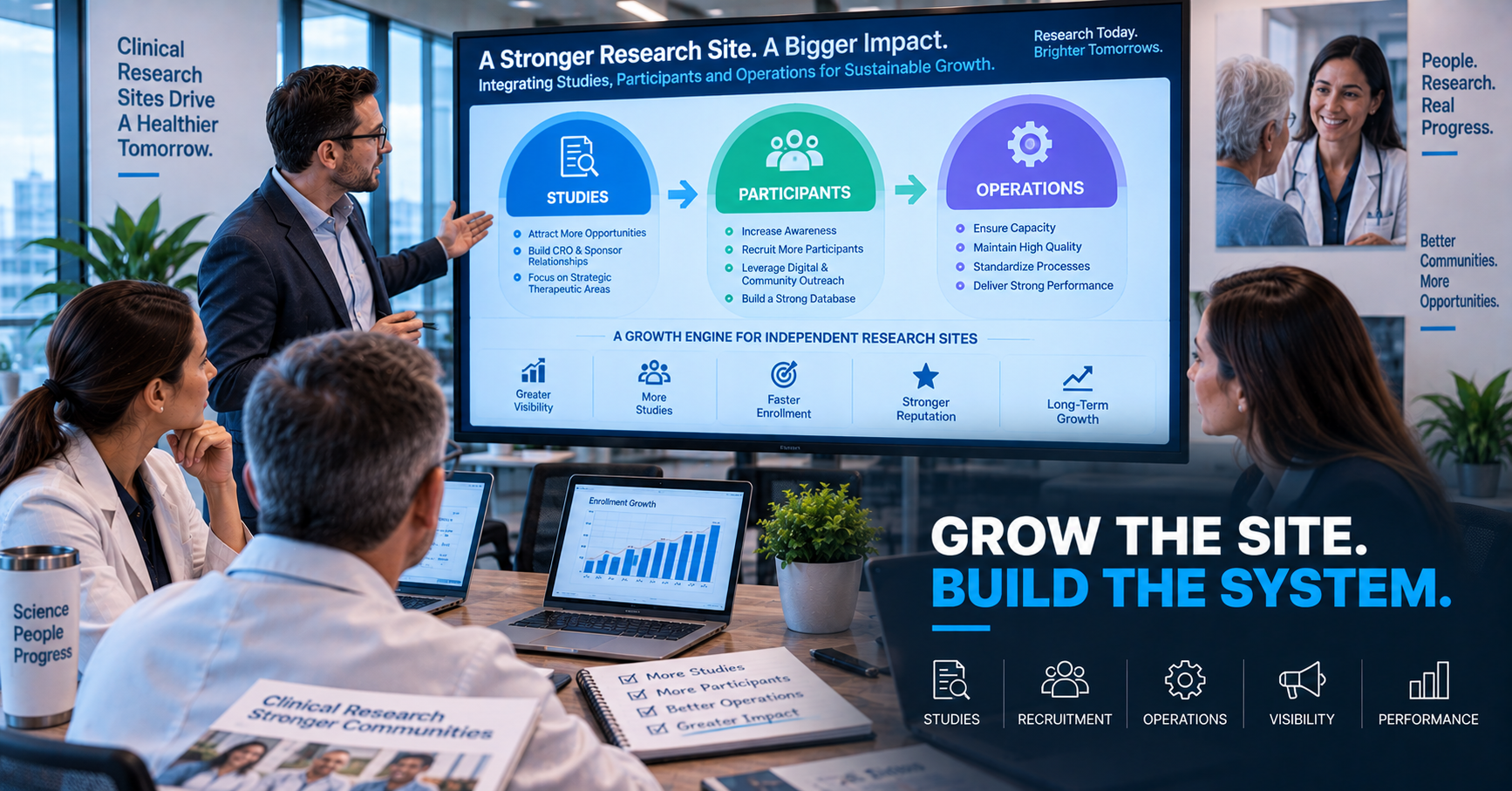
A strong Site needs three engines. Engine 1 is Studies — business development. Engine 2 is Participants — recruitment. Engine 3 is Execution — operations. If any one fails, the others suffer: Studies without participants means enrollment fails; participants without Studies means the database has no immediate value; and Studies and participants without operations means quality suffers. Growth requires all three.
Marketing Connects the Three Engines
Marketing can support the Study pipeline through Sponsor and CRO visibility, the participant pipeline through recruitment campaigns, and Site reputation through digital presence and communication. That is why Research Site marketing should not be reduced to Facebook Ads. It is part of the Site’s growth infrastructure.
A Practical Growth Framework
An independent Site can organize growth around seven areas:
- Positioning — define therapeutic strengths and differentiators.
- Digital presence — create a credible, useful website and professional visibility.
- Business development — build Sponsor and CRO relationships.
- Participant recruitment — develop reliable acquisition and follow-up infrastructure.
- Operations — build enough capacity to execute what business development wins.
- Measurement — track Study, recruitment, and operational performance.
- Reputation — use strong execution to create repeat opportunities.
These areas reinforce each other.
What Not to Do
Avoid chasing every Study — fit matters. Avoid promising unrealistic enrollment — it is a short-term win and a long-term risk. Avoid waiting for enrollment problems before building recruitment infrastructure — by then it is too late. Avoid running marketing without tracking downstream results — you cannot learn from what you do not measure. Avoid growing Study volume without staff capacity — growth becomes operational stress. And avoid generic positioning — the market cannot distinguish the Site.
Growth Becomes Easier When Systems Compound
The first Study may require building a creative workflow, a recruitment database, a CRM, bilingual materials, and Site dashboards. The next Study can reuse much of that infrastructure. Over time, systems compound. That is how independent Sites become scalable.
From Independent Site to Strong Research Organization
Growth does not necessarily mean becoming a huge network. A strong independent Site can remain focused and profitable. The objective is to build an organization that Sponsors and CROs trust because it consistently demonstrates reliable operations, strong recruitment, good communication, credible investigators, and measurable performance. That reputation can create repeat Study opportunities.
The Real Growth Formula
Independent Research Site growth can be summarized as a loop: More Visibility → Better Study Opportunities → Stronger Recruitment → Better Execution → Documented Performance → Greater Sponsor/CRO Trust → More Opportunities. The strongest Sites build that loop intentionally.
Related Reading
- What Is Clinical Research Marketing? A Practical Guide for Research Sites and CROs
- What Should a Clinical Research Site Look for in a Recruitment Marketing Partner?
- The Metrics That Actually Matter in Clinical Trial Recruitment Campaigns
- How to Build a Clinical Trial Recruitment Funnel
- CRM for Clinical Trial Recruitment: What Research Sites Actually Need
Frequently Asked Questions
How can an independent Clinical Research Site attract more Studies?
Sites can strengthen Sponsor and CRO visibility through therapeutic positioning, investigator presentation, professional digital presence, business-development outreach, fast feasibility response, and documented Study performance.
Is participant recruitment part of Site business development?
Yes. Strong participant recruitment capability can improve Site execution and become an important capability when Sponsors and CROs evaluate potential Sites.
Should Research Sites specialize in therapeutic areas?
Specialization can strengthen positioning, operational experience, recruitment knowledge, and investigator credibility, although the appropriate strategy depends on the Site.
What should a Research Site website include?
At minimum, it should clearly present locations, investigators, therapeutic areas, participant opportunities, Site capabilities, contact information, and a business-development path for industry partners.
What is the biggest barrier to Site growth?
There is no single barrier. Common constraints include weak Study pipelines, poor recruitment infrastructure, insufficient operational capacity, unclear positioning, and lack of performance measurement.