
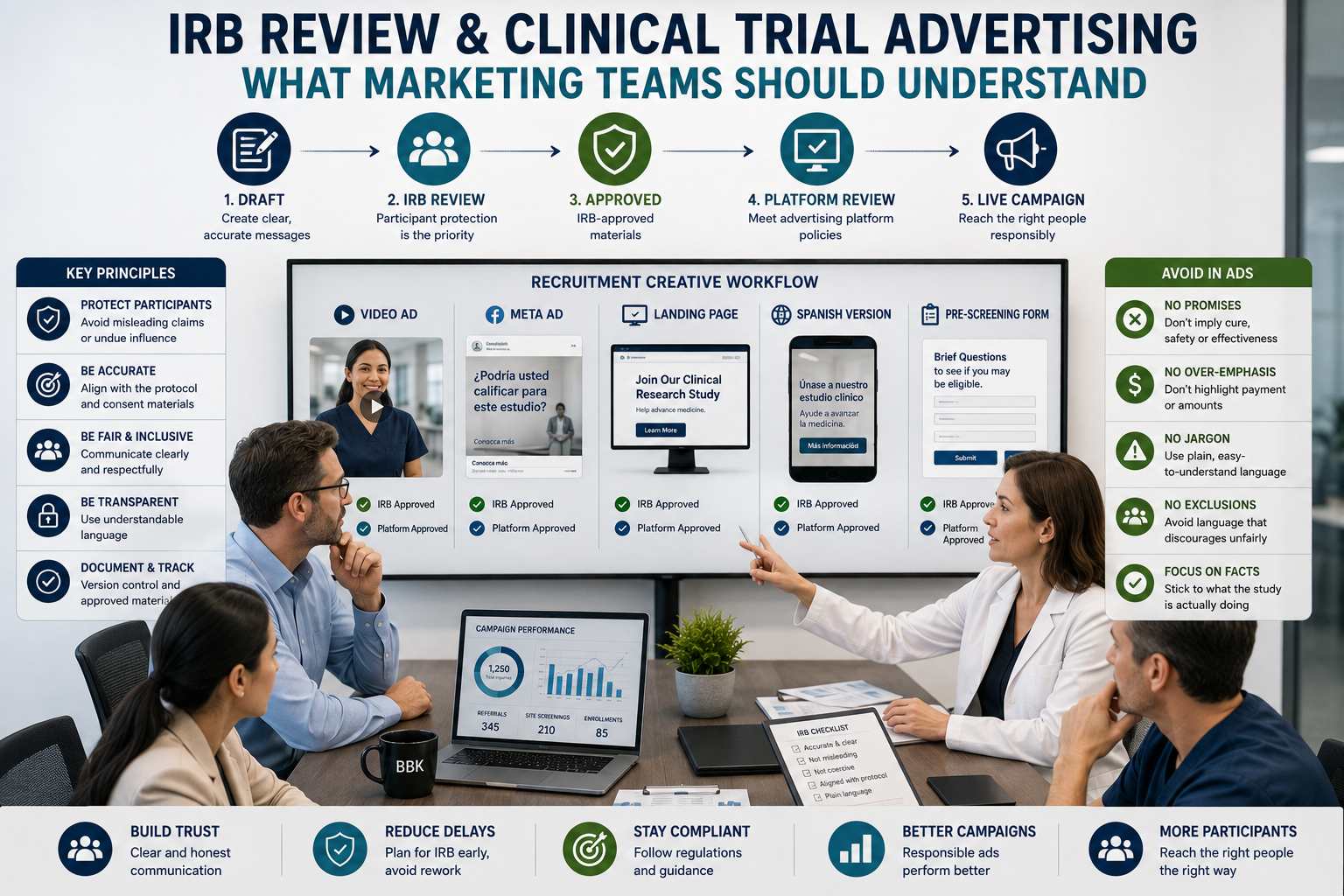
Clinical trial advertising does not operate like ordinary digital marketing.
In a conventional campaign, a marketing team might launch an advertisement, evaluate performance, change the headline, replace the image, test a new video, rewrite the landing page, and continue optimizing.
Clinical research can require a different workflow. Participant-facing recruitment materials may be subject to Institutional Review Board (IRB) review, and seemingly small creative changes can matter because the advertisement is connected to how prospective research participants first encounter the Study.
For marketing teams, that creates an important operational reality: IRB review should be built into campaign planning — not treated as an obstacle that appears after the creative is finished.
Understanding that distinction can reduce delays, avoid unnecessary production work and make clinical trial recruitment campaigns easier to manage over time.
Why Does the IRB Review Recruitment Advertising?
The purpose is not to evaluate whether an advertisement will perform well. The IRB’s role is participant protection.
FDA guidance explains that direct advertising intended to recruit research subjects is considered the beginning of the informed-consent and subject-selection process. FDA therefore expects IRBs to review recruitment methods and materials associated with covered research.
OHRP similarly interprets HHS regulations as giving IRBs responsibility for reviewing study recruitment materials, including advertisements intended to be seen or heard by prospective participants.
That means recruitment advertising is not simply marketing content about a Study. It can be part of the participant-protection framework surrounding the Study.
What Types of Recruitment Materials May Require Review?
Depending on the Study and applicable oversight, participant-facing recruitment materials may include social-media advertisements, static images, recruitment videos, radio advertisements, flyers, posters, landing pages, website recruitment pages, participant-facing forms, preliminary pre-screening scripts, telephone scripts, email or SMS recruitment messages, and other materials intended to solicit participation.
FDA specifically identifies direct advertising through media such as television, radio, newspapers, posters and flyers as recruitment advertising, and its guidance makes clear that IRBs should review the methods and materials investigators propose to use.
Digital channels change the medium. They do not eliminate the underlying issue.
Basic Clinical Trial Listings Can Be Different
Not every online reference to a Study requires the same treatment. FDA and OHRP both distinguish basic clinical-trial directory information from more promotional recruitment content.
Basic information may include Study title, purpose, protocol summary, basic eligibility criteria, Site location, and contact information.
OHRP explains that when a clinical-trial website goes beyond such basic descriptive information — for example by presenting risks and potential benefits or soliciting identifiable information — the content becomes more clearly part of the informed-consent process and requires IRB review under applicable HHS requirements.
For marketing teams, this distinction matters when building Study landing pages, Site websites, recruitment microsites, and online campaign funnels. A simple Study listing and a persuasive recruitment landing page are not necessarily equivalent.
IRB Approval Is Not Advertising-Platform Approval
This is one of the most important operational distinctions.
A recruitment advertisement can pass IRB review and still encounter a problem with Meta, Google, another advertising platform, or the technical requirements of the media channel. Likewise, a platform can approve an advertisement that still has not completed the Study’s required IRB process.
These are separate review environments.
IRB Review focuses primarily on participant protection, recruitment fairness, accuracy, coercion or undue influence, claims, and consistency with the protocol and consent materials.
Advertising Platform Review may focus on platform advertising policies, prohibited or restricted content, health-related personalization, landing-page behavior, data collection, technical specifications, and platform-specific requirements.
Marketing teams need to design for both. Otherwise the process becomes: IRB approves → platform rejects → creative changes → IRB resubmission → delay. Better planning reduces that cycle.
What Is the IRB Looking for in an Advertisement?
FDA guidance identifies several major concerns. The advertisement should not be coercive, misleading, excessively focused on payment, or written in a way that promises benefits beyond what the protocol and consent materials support.
The goal is not to prevent advertising from being attractive. It is to prevent persuasion from becoming misleading or inappropriate. That distinction is central to clinical research marketing.
Do Not Promise a Cure or Favorable Outcome
Clinical research exists precisely because something is still being investigated. Recruitment advertising should therefore avoid statements implying certainty.
Examples of problematic concepts include “this treatment will improve your condition,” “get access to a better therapy,” and “join the Study and finally get relief.”
FDA explicitly states that recruitment advertising should not promise a certainty of cure or favorable outcome beyond what is supported by the protocol and informed-consent materials. A recruitment advertisement can communicate the opportunity. It should not predetermine the research result.
Be Careful With the Word “Treatment”
Words matter. FDA specifically cautions against describing investigational drugs, biologics or devices using terms such as “new treatment,” “new medication,” or “new drug” without making clear that the product is investigational.
Why? Because the word treatment can imply that the product is already known to provide therapeutic benefit. In research recruitment, a more accurate formulation may be “a clinical research Study evaluating an investigational medication…” depending on the Study and approved language.
Marketing teams need to understand this difference because conventional advertising vocabulary can create unintended implications.
Avoid Claims That an Investigational Product Is Safe or Effective
This rule is especially important. FDA guidance states that advertisements should not explicitly or implicitly represent an investigational drug, biologic or device as safe or effective for the purpose being studied, nor suggest that it is equivalent or superior to another product.
That means creative should avoid concepts such as “safer option,” “better than your current medication,” “proven solution,” and “effective new therapy,” unless the statement is legitimately permitted within the applicable context — which ordinarily is not how an investigational product should be promoted for recruitment.
Clinical research marketing needs to generate interest without transforming uncertainty into certainty.
Compensation Should Not Become the Advertisement
Participant compensation can be legitimate information. But it requires careful presentation.
FDA guidance states that recruitment advertising may mention payment but should not emphasize the payment or amount through presentation such as unusually large or bold type. It also cautions against describing research participation as “free medical treatment” when the actual meaning is simply that subjects will not be charged for taking part in the investigation.
This creates a useful creative principle: compensation can be part of the information. It should not become the emotional center of the advertisement. An advertisement dominated by “EARN $1,000” communicates something very different from one explaining the Study and appropriately noting compensation later.
What Information Can Recruitment Advertising Include?
FDA guidance says recruitment advertisements should generally be limited to information prospective subjects need to determine their eligibility and interest.
Appropriately worded content may include the investigator or Research Site, the condition or purpose of the research, summary eligibility criteria, a brief description of participation benefits if any, time commitments, Study location, and contact information.
This is useful for marketing teams because it helps define the advertisement’s job. A recruitment ad does not need to explain the complete protocol. It needs to provide enough information for the intended audience to decide: “this may be relevant to me. I want to learn more.”
The Advertisement Is Only the First Recruitment Material
Digital recruitment rarely ends at the advertisement. A prospective participant may move through:
Ad → Landing Page or Meta Form → Preliminary Questions → Confirmation Message → Telephone / SMS / Email → Site Referral
Many of those participant-facing steps may themselves require appropriate consideration within the recruitment-material workflow.
Marketing teams should therefore avoid thinking only in terms of “the approved ad.” The real question is “has the participant journey been reviewed appropriately?” That can prevent a situation where the advertising image is approved but the landing page has different claims, the form asks unreviewed recruitment questions, the confirmation message changes expectations, or the call script introduces language that was never considered.
Pre-Screening Scripts Deserve Particular Attention
FDA’s recruitment guidance specifically discusses receptionist scripts used during the first contact with prospective participants. These scripts may be used to determine basic eligibility. But they can also involve collection of personal or sensitive information.
FDA notes that IRBs should consider issues such as how information is handled, whether a marketing company collects it, whether names are retained, whether data may be shared or sold, what happens to information when someone does not continue, and how records are protected or destroyed.
That section is highly relevant to modern digital recruitment. Today’s equivalent may not be a receptionist holding a paper script. It may be an online pre-screen, automated questionnaire, call center, CRM workflow, recruitment vendor, or participant recruitment platform. The technology changed. The underlying participant-protection questions did not.
Video Requires Special Planning
Video is one of the most difficult recruitment formats to revise.
Suppose a Site produces a polished advertisement involving a physician, camera crew, professional location, lighting, editing, subtitles, and motion graphics. Then the IRB requests one sentence to change. The entire video may need to be modified or recorded again.
FDA anticipated this operational problem long before social-media video existed. Its guidance notes that IRBs may review advertising wording before final taping specifically to avoid unnecessary re-recording caused by inappropriate language. Final audio/video material can then be reviewed after production.
For today’s marketing team, the lesson is extremely practical: approve the script before spending heavily on production whenever the workflow permits.
A Better Video Workflow
Instead of Script → Production → Editing → IRB → Changes → Re-record, consider:
Concept → Script → Internal Regulatory/Study Review → IRB Review as Required → Production → Final Material Review as Applicable → Campaign Launch
This can save time, production expense, physician availability, editing work, and campaign delays. It also allows the creative team to focus on execution once the messaging foundation is stable.
Plan Multiple Creative Variations Early
Digital advertising requires creative refreshes. IRB-controlled recruitment can make spontaneous changes difficult. That tension should be solved during planning.
For example, a campaign may prepare several approved alternatives: headline versions A, B, and C; a participant-focused static image, a Research Site visual, and a physician-presenter visual; 30-second and 15-second video, in vertical and horizontal format; and English and Spanish language versions.
The exact approach depends on the Study and IRB. But the strategic principle remains: ask for enough creative flexibility before launch to support realistic digital campaign optimization later.
Version Control Is Critical
Once multiple versions exist, another problem emerges. Which version is approved?
Marketing teams should maintain a controlled record such as:
| Material | Version | Language | IRB Status | Platform Status | Live Status |
|---|---|---|---|---|---|
| Meta Video | V1.2 | EN | Approved | Approved | Live |
| Meta Video | V1.2 | ES | Approved | Approved | Live |
| Static Ad A | V2.0 | EN | Approved | Approved | Paused |
| Lead Form | V1.4 | EN | Approved | Approved | Live |
The actual system may be more sophisticated. What matters is that nobody accidentally uploads the wrong draft. A seemingly harmless mistake can result in an unapproved participant-facing version entering circulation.
Keep Approved and Working Files Separate
One practical discipline is maintaining separate locations for working creative (drafts and revisions), submitted creative (exactly what went to the IRB), approved creative (locked final versions), and platform versions (the actual files currently running).
This becomes particularly important when managing multiple Studies, multiple Sites, bilingual campaigns, many advertisements, and creative refreshes. Without structure, filenames such as FINAL-V2-NEW-FINAL-APPROVED-2.mp4 eventually appear. That is not a reliable compliance system.
Small Creative Changes May Not Be Operationally Small
Marketing teams naturally think in terms of testing. Change “Learn More” to “Register Today.” Change “Research Study” to “Treatment Study.” Change a physician’s sentence. Add compensation. Remove an age requirement.
In ordinary advertising, these can seem like small optimizations. In clinical research, wording can alter participant expectations, perceived eligibility, benefit implications, urgency, or the meaning of the recruitment opportunity.
Therefore, teams should not assume small design change equals insignificant recruitment change. The applicable Study and IRB process determines what can be modified and how.
Platform Rejection Can Create an IRB Workflow Problem
Imagine the following: the IRB approves a Meta advertisement. Meta rejects it. Marketing changes the wording. Meta approves the new version. Marketing launches it.
There may now be a serious problem: the platform-approved creative may not be the IRB-approved creative.
This is why platform policy should be considered before IRB submission whenever possible. The marketing team should understand likely Meta policy constraints, Google policy constraints, health-related advertising restrictions, format requirements, and landing-page rules. That reduces the chance of having to redesign approved recruitment materials after platform review.
Marketing and Regulatory Teams Should Work Together Early
One of the least efficient workflows is: marketing creates → regulatory rejects → marketing recreates.
A better model involves early alignment. Marketing understands audience, digital behavior, creative, platform requirements, and conversion. Research/regulatory stakeholders understand protocol, approved claims, participant protections, consent, and Study requirements.
Neither group should attempt to perform the other’s job. But they should collaborate. The goal is marketing that performs within the Study’s regulatory framework.
The IRB Is Not the Marketing Department
There is also an important boundary. The IRB should not be expected to design the campaign.
Marketing should bring forward strategically developed messaging, professionally designed materials, appropriate variants, and clear rationale. The IRB’s role is to review the research-recruitment materials within its oversight responsibilities.
A campaign that depends on the IRB to fix bad marketing is already inefficient. The better workflow is: create strong, responsible recruitment creative first. Then submit it appropriately.
Do Not Use “IRB-Approved” as a Marketing Claim to Participants
The fact that a recruitment material has gone through IRB review is part of the research oversight process. It should not be turned into a promotional endorsement.
An advertisement should not imply “this Study is safe because the IRB approved it.” IRB review does not mean an investigational product has been proven safe or effective. Nor is the IRB acting as a commercial endorsement of the Study. The purpose of review is participant protection. Marketing should preserve that distinction.
IRB Review Does Not Guarantee Good Recruitment Creative
The reverse is also important. An advertisement can be compliant and still perform poorly. It may be too complicated, visually weak, difficult to read on mobile, poorly localized, excessively technical, or unclear about the next step.
IRB approval answers regulatory and participant-protection questions. It does not answer: will the right audience understand and engage with this advertisement? That remains the responsibility of the recruitment marketing team.
Strong clinical research advertising needs both responsible messaging and effective communication.
A Practical IRB-Aware Recruitment Creative Workflow
A useful marketing process can look like this:
- Study Review — understand target population, condition, geography, major eligibility concepts, participant burden, recruitment objective.
- Campaign Strategy — define target audience, channels, formats, language, participant journey.
- Creative Planning — prepare scripts, ad concepts, forms, landing-page content, follow-up messaging.
- Internal Review — check protocol alignment, terminology, claims, platform compatibility.
- IRB Submission — submit required participant-facing recruitment materials.
- Production — finalize video, static creative, translated/localized versions, forms.
- Platform Review — submit advertisements through the relevant advertising platform.
- Launch — use only the approved and appropriate versions.
- Performance Monitoring — track advertising performance, inquiries, pre-screening, referrals, downstream results.
- Controlled Optimization — when changes are required, determine whether updated material needs additional Study/IRB review before launch.
This workflow treats IRB considerations as part of marketing operations rather than an external interruption.
Related Reading
- What Makes Clinical Research Marketing Different From Traditional Healthcare Marketing?
- How to Build a Digital Recruitment Strategy for a Clinical Research Study
- Preparing Recruitment Materials for IRB Review: A Practical Guide for Marketing Teams
- Translation vs Localization in Clinical Trial Advertising
Frequently Asked Questions
Does an IRB need to review clinical trial advertising?
For covered research, IRBs generally review participant-facing recruitment materials as part of their responsibility to protect research subjects. FDA specifically considers direct recruitment advertising the beginning of the informed-consent and subject-selection process.
Does every clinical trial website require IRB review?
Not necessarily. OHRP distinguishes basic directory-style Study information from content that goes beyond a listing, such as more detailed recruitment information, risk/benefit descriptions or solicitation of identifiable information.
Can clinical trial ads mention participant compensation?
Yes, compensation may be mentioned when appropriate, but FDA cautions against emphasizing payment or the amount in a way that could create undue influence.
Can recruitment advertising call an investigational product a new treatment?
FDA cautions against terms such as “new treatment,” “new medication” or “new drug” unless the investigational nature is adequately explained, because such wording may imply proven therapeutic value.
If Meta or Google rejects an IRB-approved advertisement, can marketing simply rewrite it?
Not automatically. A rewritten advertisement may no longer match the version previously approved for the Study. The appropriate review process should be determined before the revised material is launched.