
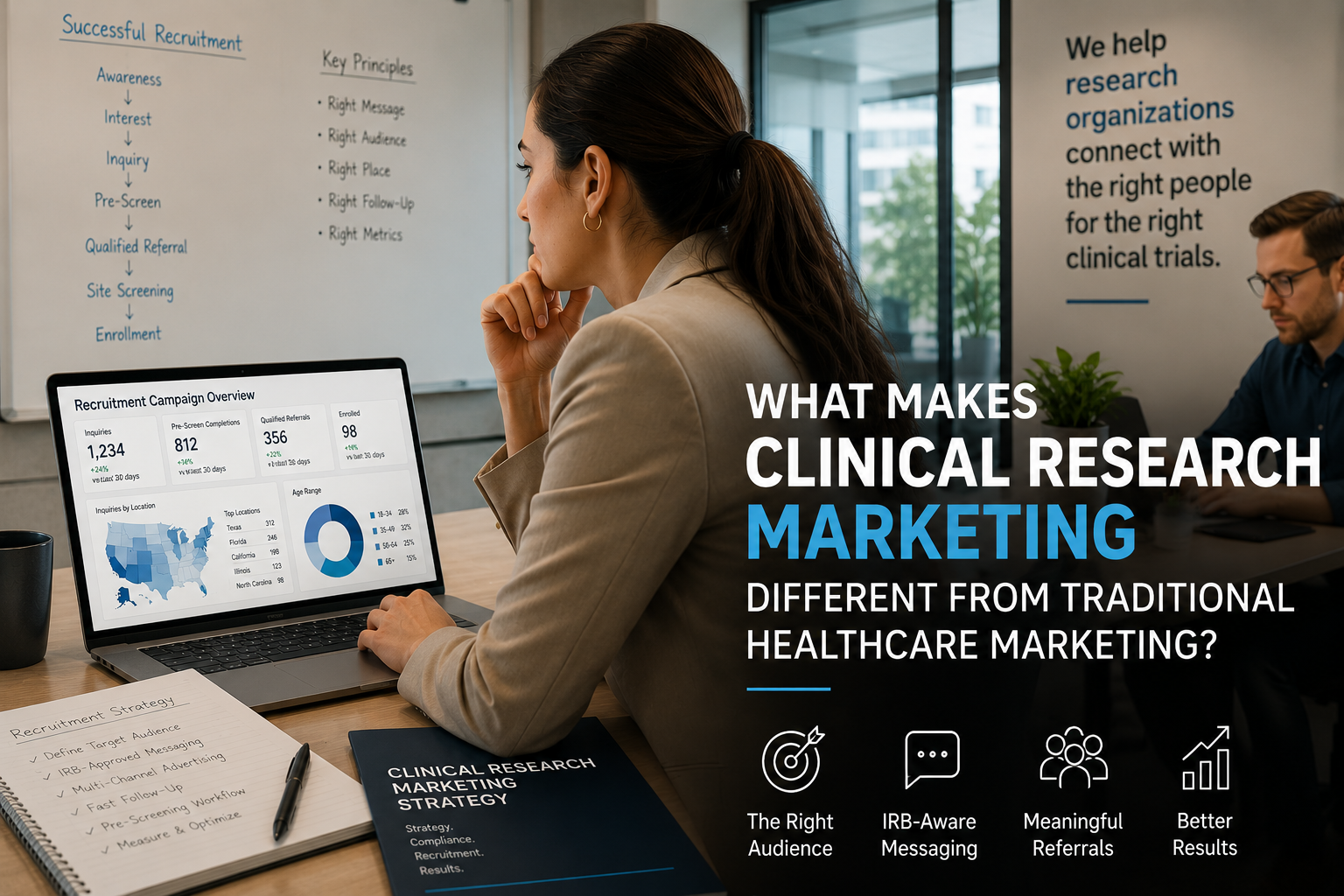
Clinical research marketing and traditional healthcare marketing may appear similar at first glance. Both operate in healthcare-related environments, communicate with patients or consumers, and increasingly rely on digital channels to reach specific audiences.
But the similarities can be misleading.
Marketing a medical practice, hospital, dental office, or healthcare service typically focuses on attracting people who already have a reason to seek care. Clinical research marketing must solve a different problem: identifying people who may have an interest in research participation, communicating an unfamiliar opportunity responsibly, moving them through a recruitment process, and ultimately helping a research organization identify potential participants who may fit a specific protocol.
That distinction changes almost everything — from audience strategy and creative development to regulatory review, campaign measurement, follow-up, and the definition of a successful conversion.
For Research Sites, CROs, SMOs, Sponsors, and recruitment teams, understanding this difference is essential before building a digital recruitment strategy.
Healthcare Marketing Usually Starts With Existing Demand
Traditional healthcare marketing often captures demand that already exists.
Someone searching for:
- a cardiologist near them,
- an urgent care center,
- a dermatologist,
- a dental procedure, or
- a particular healthcare service
usually understands the basic service they are looking for.
The marketer’s challenge is largely to make one provider visible, credible, convenient, and preferable to competing options.
Clinical research recruitment frequently begins much earlier in the decision process.
A person seeing an advertisement for a clinical study may never have considered participating in research. They may not understand how a clinical trial works, what participation involves, whether the opportunity is relevant to them, or what happens after they respond.
The campaign therefore has to do more than generate attention. It must create an appropriate bridge between awareness and informed interest.
That makes participant communication, expectation setting, response time, preliminary qualification, and follow-up part of the marketing system — not simply tasks that occur after the marketing ends.
Clinical Research Marketing Is Not the Same as Advertising
This distinction is particularly important.
Advertising is one component of clinical research marketing, but it is not the entire strategy.
A 2026 scoping review examining marketing strategies used to improve clinical-trial recruitment and retention identified 61 relevant articles. Most focused on recruitment, and social media and online advertising were among the most frequently reported promotional methods. The authors also observed that clinical-trial marketing has tended to concentrate heavily on promotion rather than using marketing as a broader strategic discipline.
A complete clinical research marketing strategy can extend beyond the advertisement itself to include:
- study positioning,
- audience and geographic strategy,
- recruitment creative,
- participant-facing messaging,
- landing pages or recruitment forms,
- preliminary pre-screening workflows,
- communication systems,
- lead and referral routing,
- follow-up processes,
- recruitment analytics, and
- the overall participant experience before contact with the Research Site.
This is one of the most important differences between simply buying advertising and building a recruitment operation.
A Meta campaign can generate inquiries. It cannot, by itself, guarantee that those inquiries become meaningful participant opportunities.
Recruitment Advertising Operates Within a Different Regulatory Environment
Clinical research also introduces considerations that do not normally exist in conventional healthcare advertising.
The FDA considers direct advertising intended to recruit research subjects part of the informed-consent and subject-selection process. FDA guidance states that an IRB should review the methods and materials investigators propose to use for recruitment and should evaluate recruitment advertising to ensure, among other things, that it is not coercive and does not promise benefits or favorable outcomes beyond what is supported by the protocol and consent materials.
OHRP similarly recognizes IRB authority and responsibility over recruitment materials in HHS-conducted or supported research, including certain website content used to recruit prospective participants.
This has practical marketing consequences.
In traditional digital marketing, an advertiser may test new headlines, offers, videos, or landing-page variations rapidly. Clinical research recruitment may require a more controlled creative workflow because participant-facing materials can be subject to IRB review and approval depending on the study and circumstances.
Marketing teams therefore need to think ahead. Instead of treating regulatory review as something that happens after the creative is finished, the recruitment strategy should account for it during planning. That means developing clear messaging, appropriate calls to action, usable creative variations, accurate eligibility language, and version control from the beginning.
Effective clinical research marketing requires creativity within a controlled environment.
A Lead Is Not the Final Conversion
Perhaps the biggest operational mistake in clinical research marketing is measuring success as though the campaign were an ordinary lead-generation campaign.
Imagine two recruitment campaigns.
Campaign A produces 200 inquiries at $20 per lead. Campaign B produces 100 inquiries at $30 per lead.
Traditional performance marketing might immediately favor Campaign A.
But suppose only a small fraction of Campaign A’s inquiries appear relevant after preliminary qualification, while Campaign B produces substantially more usable participant referrals.
Suddenly, the cheaper campaign is not necessarily the more effective one.
The point is not that CPL has no value. Cost Per Lead is useful for measuring advertising efficiency. It simply cannot tell the entire recruitment story.
Clinical research teams should think in terms of a funnel:
Advertising → Inquiry → Response → Preliminary Qualification → Referral → Site Screening → Enrollment
Each stage changes the economic value of the previous one.
This is why metrics such as cost per usable referral, pre-screen completion, contact rate, qualification rate, screening rate, and ultimately enrollment can provide more meaningful context than CPL alone.
The goal is not simply to produce more names in a database. The goal is to create real participant opportunities for the study.
Geography Matters More Than Many Marketers Expect
Clinical research recruitment is also constrained by geography in a way that many conventional digital campaigns are not.
A national healthcare brand may value a consumer anywhere within its service network. A clinical Research Site usually needs potential participants who can realistically reach a specific location and comply with the study’s visit requirements.
That makes geographic strategy part of recruitment economics.
The relevant question is not simply:
“Where can we find the cheapest leads?”
It is:
“Where can we find potentially relevant participants who can realistically complete the next stages of this study?”
For multi-site studies, this becomes even more complex. Recruitment teams may need to consider:
- different population densities,
- competing Sites,
- travel distance,
- demographic distribution,
- condition prevalence,
- advertising costs,
- site capacity, and
- recruitment performance by geography.
This is why allocating identical advertising budgets to every Site does not automatically produce an efficient multi-site recruitment strategy.
Follow-Up Is Part of Marketing Performance
There is another important difference between healthcare advertising and clinical research recruitment: the value of an inquiry can deteriorate quickly when the next step is unclear or delayed.
A potential participant may respond to an advertisement at 9:30 p.m. on a Saturday. The advertising platform has done its job. The campaign has generated the inquiry. But the recruitment process is not finished.
What happens next? Does the person receive confirmation? Can they complete preliminary questions? Do they understand what to expect? When will someone contact them? Can the appropriate Research Site see the referral?
These operational questions directly affect the performance of marketing spend.
If a campaign generates demand faster than the organization can respond to it, increasing the advertising budget may simply increase the amount of recruitment opportunity that gets lost.
For that reason, clinical research marketing should be connected to participant engagement and recruitment operations, rather than functioning as an isolated advertising department.
Trust Has a Different Role in Clinical Research
Healthcare consumers generally understand the relationship they are entering: they need care and are choosing a provider.
A potential research participant faces a different decision. They may be encountering an investigational study, an unfamiliar Research Site, new terminology, eligibility questions, and a process they have never experienced before.
Communication therefore has to balance several objectives: attract attention without sensationalism, explain without overwhelming, encourage action without creating inappropriate expectations, and build trust without implying guaranteed medical benefit.
FDA recruitment guidance specifically cautions against claims that an investigational drug, biologic, or device is safe or effective for the purpose being studied and against language that can imply proven benefit.
Good recruitment creative is therefore not simply persuasive creative. It is clear, credible, participant-oriented communication designed for a regulated research environment.
Research Site Marketing Goes Beyond Participant Recruitment
Clinical research marketing also has a B2B dimension that traditional patient acquisition does not fully capture.
Research Sites need participants, but they may also need visibility with:
- Sponsors,
- CROs,
- investigators,
- referral networks,
- community partners, and
- potential business-development relationships.
A strong Research Site marketing strategy can therefore serve two different audiences. One side supports participant recruitment. The other supports organizational growth and positioning.
Web presence, branding, capabilities presentation, therapeutic-area positioning, digital credibility, recruitment infrastructure, and business-development communications can all influence how a Research Site is perceived before a new study opportunity ever reaches the organization.
Clinical research marketing should therefore not be reduced to “run Facebook ads when enrollment is slow.” That is a tactical response. The stronger approach is to build a marketing system that supports recruitment and business growth continuously.
The Better Question Isn’t “Which Advertising Platform Should We Use?”
Research organizations often begin digital recruitment planning by asking whether they should use Meta or Google.
That question matters, but it comes too early.
A stronger strategy begins with:
- What Study are we recruiting for?
- Who is the appropriate audience?
- Where are potential participants located?
- What participant-facing messaging is appropriate?
- What materials require review?
- What happens immediately after someone responds?
- How will preliminary qualification work?
- How will referrals reach the Site?
- How quickly will potential participants be contacted?
- Which metrics will determine whether recruitment is actually working?
Only then should channel selection become the central question.
That is what makes clinical research marketing fundamentally different from ordinary healthcare promotion. It combines marketing strategy, participant recruitment, digital advertising, controlled creative development, communication workflows, measurement, and operational execution.
The advertisement is important. The system behind the advertisement is what determines whether attention becomes recruitment opportunity.
Related Reading
- Clinical Trial Patient Recruitment: From Advertising Clicks to Real Participant Opportunities
- Why Research Sites Should Stop Measuring Recruitment Success by Leads Alone
- IRB Review and Clinical Trial Advertising: What Marketing Teams Should Understand
- What Should a Clinical Research Site Look for in a Recruitment Marketing Partner?
- What Is Clinical Research Marketing? A Practical Guide for Research Sites and CROs
Frequently Asked Questions
What is clinical research marketing?
Clinical research marketing is the use of marketing strategy, communication, digital channels, recruitment systems, and business-development activities to support Research Sites, CROs, SMOs, Sponsors, clinical studies, and participant recruitment. It can include advertising but is broader than advertising alone.
Is clinical trial recruitment advertising allowed?
Yes. FDA guidance states that direct advertising for research subjects is not inherently objectionable, but recruitment methods and participant-facing advertising may be subject to IRB review and other applicable requirements. Recruitment materials should be developed within the regulatory framework applicable to the particular study.
Is Cost Per Lead the most important clinical trial recruitment metric?
CPL is useful for understanding advertising efficiency, but it does not show whether inquiries become appropriate referrals, screenings, or enrolled participants. Recruitment performance should be evaluated across the full funnel.
How is clinical research marketing different from patient recruitment?
Participant or patient recruitment is one important function within clinical research marketing. Clinical research marketing can also include Research Site positioning, business development, branding, digital presence, multi-site strategy, recruitment technology, and communication systems.
Can a traditional healthcare marketing agency run clinical trial recruitment campaigns?
A general agency may understand advertising platforms, but clinical research recruitment introduces additional operational and regulatory considerations. Organizations should evaluate whether a marketing partner understands Research Sites, recruitment funnels, IRB-aware creative workflows, participant communication, geographic recruitment, and meaningful recruitment metrics — not only media buying.