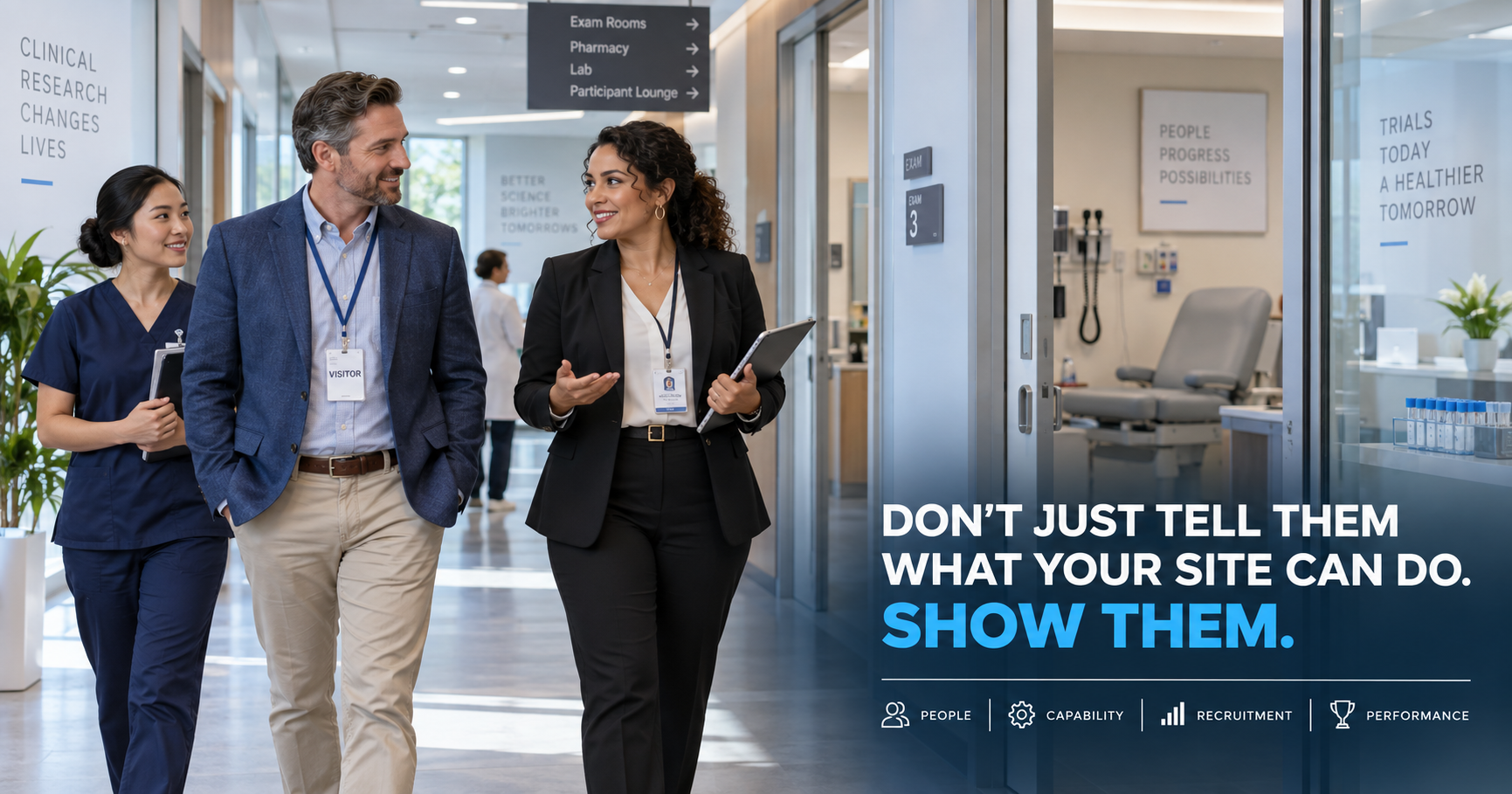
Research Sites often market themselves by describing who they are. Sponsors and CROs are more interested in understanding what the Site can actually do. That difference matters.
A Site may describe itself as experienced, innovative, patient-focused, responsive, and committed to quality. Those statements are positive, but they do not answer the questions that influence Site selection. A Sponsor or CRO needs to understand whether the Site can execute the protocol, whether it has the right investigator, whether it has access to the right population, whether it can recruit, whether it has enough staff, whether it can meet timelines, whether it has performed well before, and whether communication will be reliable. Effective Site marketing should make those answers easier to see.
Site Marketing Is Not Traditional Advertising
Marketing a Research Site to participants is primarily B2C. Marketing a Research Site to Sponsors and CROs is B2B, and the audiences behave differently. Participants may respond to awareness, trust, Study relevance, and location. Sponsors and CROs evaluate capability, risk, performance, feasibility, and responsiveness. The marketing strategy therefore needs different proof.
Think Like a Site-Selection Team
A useful exercise is to stop thinking like the Site for a moment. Imagine you are responsible for placing a Study across 30 locations. You have dozens of candidate Sites, limited time, enrollment deadlines, startup targets, protocol complexity, and budget pressure. Which Site is easier to shortlist?
Site A says: “We are committed to advancing medicine through innovative clinical research.” Site B clearly shows three relevant investigators, prior experience in the indication, bilingual recruitment capability, geographic patient access, prior enrollment performance, and a dedicated feasibility contact. Site B is easier to evaluate. That is the goal of B2B Site marketing.
Modern Feasibility Is Broader Than One Questionnaire
A 2024 paper from an industry Site Feasibility Task Force — made up of representatives from Sponsors, CROs, and Sites — divided Site feasibility into four areas (Contemporary Clinical Trials Communications, 2024):
- Site profile: basic organizational information such as address, specialty areas, number of physicians, and startup process.
- Site capability: facilities, equipment, and the laboratory tests the Site can perform.
- Site performance: past enrollment performance to target, inspection findings, and data quality metrics.
- Protocol-specific assessment: patient population estimates, referral patterns, and the ability to conduct specialized procedures.
A Site’s marketing materials should make the first three categories easier to understand before a protocol-specific questionnaire even arrives.
1. Start With a Clear Site Profile
The Sponsor should quickly understand the organization name, locations, Site type, investigators, therapeutic areas, years of research experience, and Study phases supported. Do not make the prospect search through multiple pages to understand basic information. Clarity is part of professionalism.
2. Show the Investigators
Investigators are one of the most important Site assets. Useful information may include specialty, research background, relevant therapeutic experience, clinical practice connections, and availability for research. Do not list twenty physicians without context. Show why the investigators matter to the Studies you want.
3. Explain Therapeutic Expertise
The Site should make its strongest areas immediately visible — for example, CNS, metabolic, gastroenterology, and women’s health as core therapeutic areas. If the Site has deeper specialization, explain it. A CRO evaluating a CNS Study should not have to guess whether CNS is a core strength or something the Site occasionally accepts.
4. Patient Access Needs Evidence
One of the most important Site-selection questions is whether the Site can actually reach the population. Avoid relying only on “We have access to thousands of patients.” Instead, explain the sources: the investigator’s practice, the Site database, healthcare partnerships, physician referrals, community relationships, digital recruitment, and bilingual outreach. Patient access becomes more credible when the mechanism is clear.
5. Recruitment Capability Should Be Visible
Recruitment is not just something that happens after Study award. It is a Site capability. Explain whether the Site has recruitment staff, digital advertising, a participant CRM, pre-screening workflows, bilingual recruitment, community outreach, rapid follow-up, and referral partnerships. Sponsors need to understand whether recruitment depends entirely on “the investigator knows some patients” or whether the Site has an actual system.
6. Historical Performance Is Stronger Than Promises
Sites often say “We recruit quickly.” A stronger statement is supported by verified historical data — enrollment against target, recruitment velocity, time to first participant, retention, and startup timelines. Only use data that can be substantiated. Performance creates differentiation because it lowers perceived risk.
7. Do Not Hide Operational Capacity
Recruitment alone is not enough. The Site also needs the infrastructure to execute. Sponsors and CROs may evaluate coordinator experience, investigator commitment, equipment, pharmacy, laboratory capabilities, regulatory support, quality systems, and available space.
Researchers who developed a standardized Site Assessment Survey Instrument (SASI) for trial site selection expanded the usual site survey to include standardized assessments of site commitment time, team experience, feasibility of tight timelines, and local medical community equipoise, as factors that might better predict performance (Contemporary Clinical Trials, 2024). Marketing should reflect real operational readiness along those same lines.
8. Responsiveness Is Part of the Brand
A Site can have a beautiful capabilities deck and still create a poor impression by taking six days to answer an email. The Site Feasibility Task Force paper makes the same point: Sponsors and CROs cannot accurately assess potential Site lists or plan startup timelines when Sites do not respond, and Sites may be replaced by more responsive Sites (Contemporary Clinical Trials Communications, 2024). That means responsiveness is not merely administrative. It is commercial positioning.
9. Create One Clear Business-Development Contact
Do not make a CRO guess whom to contact. Provide a clear Business Development / Feasibility contact with a name, an email, and a phone number when appropriate. Incoming opportunities should have an owner.
10. Build a Strong Capabilities Deck
The Site capabilities deck is one of the most practical B2B marketing assets. A strong deck can include a Site overview (who you are), locations (where you operate), investigators (who leads research), therapeutic areas (where you specialize), patient access (which populations you can reach), recruitment (how participants are identified and engaged), infrastructure (what the Site can support), performance (verified experience and outcomes), and a contact (who handles Study opportunities). Keep the deck concise enough to actually be read.
11. Do Not Overload the Deck
A 40-slide presentation is rarely necessary for an initial introduction. Sponsors need enough information to decide “Should we investigate this Site further?” The deck should open the door to feasibility, not replace the entire feasibility process.
12. Tailor the Message to the Opportunity
Do not send the exact same Site presentation for every Study. A dermatology Sponsor and a CNS CRO may care about different capabilities. Maintain a core Site profile, then emphasize the most relevant elements. For a CNS Study, that means investigator experience, the neurological population, caregiver recruitment, and CNS trial history. For metabolic Studies, it means endocrinology relationships, the diabetes population, bilingual recruitment, and relevant equipment. Relevance improves marketing.
13. Website and Deck Should Tell the Same Story
The Sponsor may receive the deck and then visit the website. If the deck says “CNS specialists” but the website barely mentions CNS, positioning becomes weaker. Your website, LinkedIn page, capabilities deck, and feasibility responses should present a consistent picture. Our article on building a strong digital presence for a Clinical Research Site covers how to make the website carry that story.
14. Make Recruitment Geography Concrete
If geography is an advantage, show it: Site locations, a realistic drive-time area, nearby population, bilingual communities, and referral networks. A map can sometimes communicate more than three paragraphs. Our earlier article on geographic targeting in clinical trial recruitment explains why travel reality matters to recruitment, and that same geographic intelligence can strengthen Site marketing.
15. Show Bilingual Capability Properly
Do not simply write “Spanish-speaking patients available.” If bilingual capability is important, explain the bilingual coordinators, Spanish recruitment, localized materials, Spanish pre-screening, and community access behind it. That demonstrates infrastructure rather than demographic assumption.
16. Technology Should Be Explained Through Outcomes
A weak statement is “We use advanced recruitment technology.” A better one is “Participant inquiries are tracked from registration through Site screening, allowing response times and recruitment sources to be measured.” The Sponsor cares less about the software name than about what the system allows the Site to do.
17. Performance Marketing Needs Evidence
The same principle applies to every capability. Do not say “rapid startup” unless there is a process behind it. Do not say “excellent retention” without evidence. Do not say “strong recruitment” if the Site does not track recruitment performance. Marketing should reveal reality, not manufacture it.
18. Maintain a Site Profile Before Opportunities Arrive
Do not rebuild Site information every time a CRO sends a request. Maintain updated information on investigators, licenses, Site locations, equipment, staff, experience, therapeutic areas, recruitment, and previous Study performance. This allows faster feasibility responses, and it also reduces inconsistencies.
19. Separate Evergreen Information From Protocol-Specific Feasibility
Some Site information changes slowly, such as location, equipment, investigators, and core therapeutic areas. Other information depends entirely on the Study: eligible population, competing trials, projected enrollment, and required procedures. The 2024 Site Feasibility Task Force recommended dividing Site feasibility into phases — Profile, Capability, Performance, and Protocol-Specific — so the information that rarely changes can be collected early (Contemporary Clinical Trials Communications, 2024). That distinction can make both marketing and feasibility more efficient.
20. Never Treat Patient Estimates as Sales Numbers
Feasibility can create pressure to promise “We can enroll 20.” But patient availability is not a sales quota. Estimates should consider protocol criteria, actual patient access, competing Studies, geography, recruitment channels, and Site capacity. An aggressive estimate may help the Site get selected. A missed target can hurt future credibility.
21. Explain How the Site Recruits Outside Its Own Database
Sponsors may worry about Sites that rely on one recruitment source. A stronger Site can explain multiple channels — an internal database, physician referrals, community outreach, and digital recruitment — which demonstrates resilience.
22. Quality Matters Alongside Enrollment
Site marketing should not send the message “We enroll at any cost.” Sponsors need quality data, protocol compliance, participant retention, and reliable operations. A 2026 framework for assessing site selection decisions, developed from interviews with Sponsors, CROs, and Sites, distinguishes between site inputs (resources and operating environment), dynamic capabilities (coordinated site-level abilities), and outputs (performance metrics) (Therapeutic Innovation & Regulatory Science, 2026). Enrollment is one output. It is not the entire definition of Site quality.
23. Communication Is a Competitive Advantage
Sponsor-Site collaboration remains an important operational challenge, and communication gaps run in both directions. The Site Feasibility Task Force documented Sites that do not respond to feasibility questions, but also Sponsors and CROs that are slow to answer Site questions, and recommended that both sides establish clear communication channels and a plan for timely responses (Contemporary Clinical Trials Communications, 2024). A Site can differentiate by being organized, responsive, transparent, and easy to reach. These traits become visible before Study award.
24. Do Not Wait for Sponsors to Discover You
A good website is useful. It is not a complete business-development strategy. The Site should proactively build visibility through CRO outreach, Sponsor outreach, conferences, LinkedIn, investigator networks, and professional relationships. Marketing makes the Site discoverable. Business development turns visibility into opportunity — our article on business development for Clinical Research Sites covers that process step by step.
25. Use Content to Demonstrate Expertise
Educational content can support B2B credibility — for example, content on Site recruitment strategy, bilingual recruitment, therapeutic insights, participant engagement, technology, and operational improvements. The purpose is not to publish constantly. It is to demonstrate that the organization understands the business of clinical research.
26. Make the Site Easy to Evaluate
This is perhaps the most useful principle. The Sponsor should not have to work hard to understand who you are, what you do, where you operate, whom you can recruit, and whether you can perform. Strong Site marketing reduces uncertainty.
27. Think in Terms of Risk Reduction
Sponsors are not merely looking for exciting Sites. They are managing risk. Their concerns include slow enrollment, delayed startup, inadequate staff, unrealistic feasibility, and poor data quality. Your Site marketing should answer one question: why are we a lower-risk, high-value choice for the right Study? That framing is more useful than trying to appear impressive.
28. Build a Sponsor/CRO Value Proposition
A strong Site value proposition combines relevant investigators, participant access, recruitment infrastructure, operational capacity, responsive communication, and documented performance. This is what B2B Site marketing should communicate. If the Site is still working out how to stand out, start with our guide to how Research Sites can differentiate themselves.
A Practical Sponsor/CRO Marketing Checklist
Before actively marketing the Site, verify each of these:
- Positioning: Can we explain our strongest capabilities in one paragraph?
- Investigator visibility: Are relevant investigators presented clearly?
- Therapeutic expertise: Are our strongest areas obvious?
- Patient access: Can we explain where participants come from?
- Recruitment: Can we demonstrate how we recruit?
- Operations: Can we explain our Site infrastructure?
- Performance: Do we track meaningful historical data?
- Feasibility: Can we respond accurately and quickly?
- Digital presence: Does our website support the same story?
- Business development: Is there a clear contact and follow-up process?
If several answers are no, the Site may need to strengthen its infrastructure before increasing outreach.
Marketing Should Help Sponsors Say “Yes” to the Next Step
The objective of Site marketing is not necessarily to win the Study immediately. The first objective may simply be to get shortlisted. Then to receive feasibility. Then to earn Site selection. Marketing should move the relationship forward one appropriate step at a time.
Your Site Is the Product — Performance Is the Proof
For B2B marketing purposes, the Research Site itself is the offering. Its value comes from people, population, systems, execution, and results. Branding communicates that value. Performance proves it.
Related Reading
- How to Grow an Independent Clinical Research Site
- Building a Strong Digital Presence for a Clinical Research Site
- How Research Sites Can Differentiate Themselves in a Competitive Clinical Research Market
- Business Development for Clinical Research Sites: How to Build a Stronger Study Pipeline
- How to Measure Recruitment Performance by Research Site
Frequently Asked Questions
What should Research Sites show Sponsors and CROs?
Sites should clearly communicate investigators, therapeutic areas, patient access, recruitment infrastructure, operational capabilities, geographic reach, historical performance, and business-development contact information.
What information matters during Site feasibility?
Feasibility typically includes general Site profile, Site capabilities, historical performance, and protocol-specific assessments such as patient population and ability to perform required procedures.
Should Research Sites publish performance data?
Verified performance information can strengthen positioning where appropriate, but Sites should avoid unsupported or misleading claims.
Why is responsiveness important in Site marketing?
Sponsors and CROs operate under tight timelines. Slow feasibility and communication can delay selection and can cause a Site to be replaced by more responsive alternatives.
Is a capabilities deck enough to win more Studies?
No. It is a useful sales asset, but Site selection ultimately depends on protocol fit, investigators, participant access, operations, feasibility, and actual performance.