
Recruiting participants for one Research Site is already complex. Recruiting for ten Sites creates a different problem entirely.
Now the organization must coordinate multiple geographic markets, different Site capacities, overlapping recruitment territories, varying advertising costs, local population differences, referral routing, Site-level performance, creative consistency, and a shared recruitment budget.
That creates an important strategic decision: should each Site manage its own recruitment advertising, or should recruitment be coordinated through one centralized campaign?
Both models can work. Neither is automatically correct for every Study. The more useful question is: which parts of recruitment should be centralized, which should remain local, and how should performance determine where resources go?
What Is a Centralized Multi-Site Recruitment Campaign?
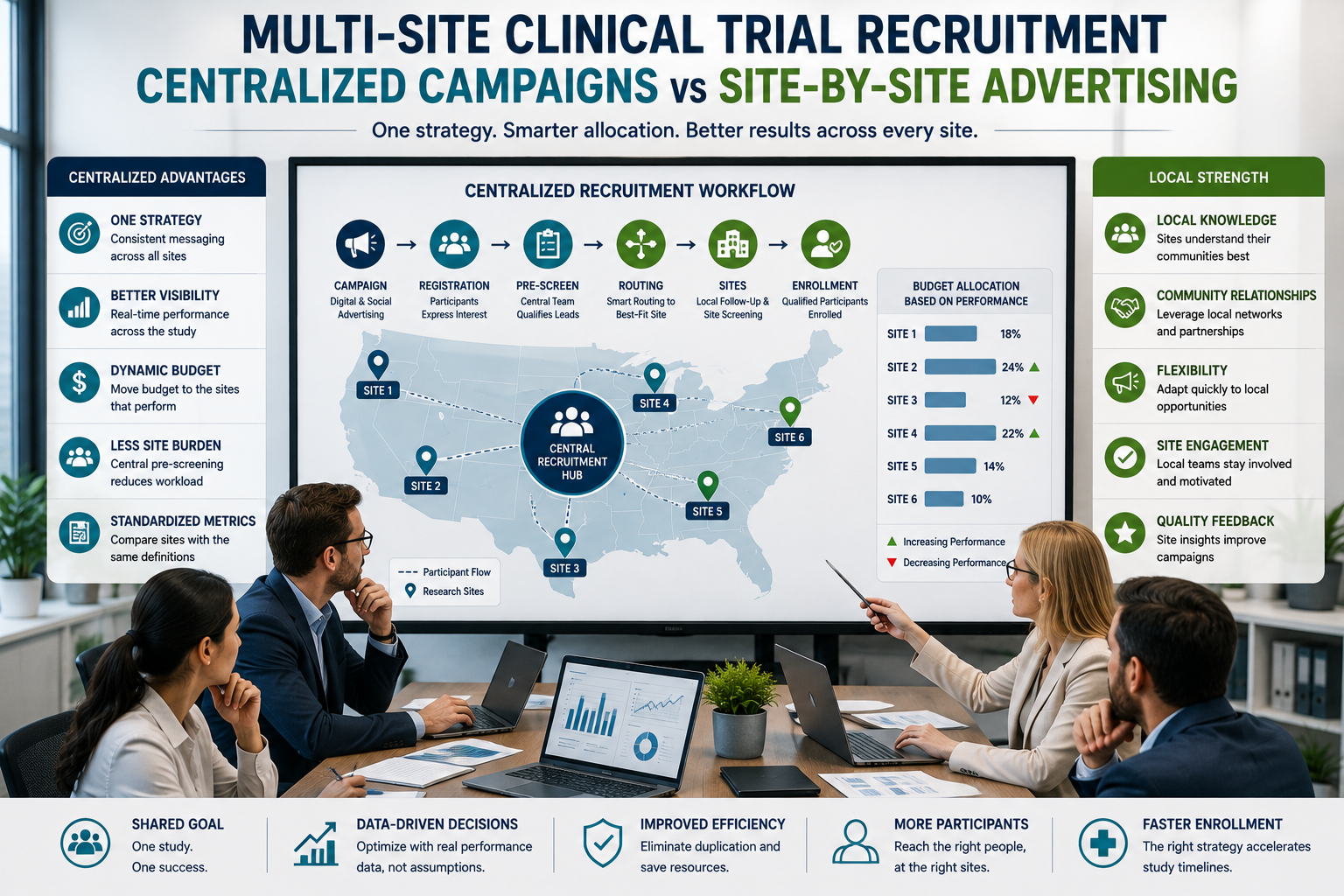
In a centralized model, the Sponsor, CRO, SMO or recruitment partner manages a substantial portion of participant acquisition across multiple Sites. Instead of ten independent advertising programs, the Study may operate under one coordinated recruitment structure. That can include common recruitment strategy, centralized media buying, standardized creative, shared reporting, geographic segmentation, centralized preliminary pre-screening, and referral routing to individual Sites.
The participant journey might look like:
Central Campaign → Participant Inquiry → Preliminary Pre-Screening → Geographic / Operational Routing → Local Research Site → Site Screening → Enrollment
The local Site still performs its appropriate research responsibilities. What changes is how participant opportunities are generated and distributed.
What Is Site-by-Site Advertising?
In a decentralized model, each participating Research Site manages much or all of its own local recruitment activity. Site A may run Meta Ads. Site B may use Google. Site C may rely heavily on physician referrals. Site D may use community outreach. Site E may already have a strong participant database and need very little paid advertising.
This provides considerable local flexibility. Each Site can adapt recruitment to its own market. But it also creates fragmentation. The Study may end up with different vendors, different advertisements, different metrics, different definitions of a lead, different follow-up systems, and limited visibility into overall recruitment performance. The larger the Site network becomes, the harder that fragmentation can be to manage.
Centralized Recruitment Is Already a Significant Industry Strategy
Centralized patient outreach is not simply a theoretical model. A 2026 study from the Tufts Center for the Study of Drug Development analyzed centralized patient-outreach recruitment spending across 32 clinical studies conducted by eight Sponsors and CROs.
Across six therapeutic areas, the median centralized outreach budget exceeded $1.3 million, and social media — including Facebook, Instagram and Google advertising — represented an average of 64.7% of centralized patient-outreach budgets. The specific costs varied substantially by therapeutic area. That variation is itself important — there is no universal cost structure for recruitment. But the data demonstrate that Sponsors and CROs are investing meaningfully in centralized recruitment infrastructure rather than relying entirely on independent Site-level activity.
Advantage 1: One Recruitment Strategy Across the Study
Centralization can create strategic consistency. Instead of every Site deciding independently what the campaign should say, which channels to use, how inquiries should be handled, and which metrics matter, the Study can establish one broader recruitment framework.
That may improve consistency across Study positioning, participant messaging, creative standards, funnel definitions, reporting, and performance expectations. For CROs and Sponsors, that visibility can be particularly valuable. The central team can see the entire recruitment landscape rather than receiving isolated updates from each Site.
Advantage 2: Centralized Creative Can Reduce Duplication
Imagine a 12-Site Study. Under a fully decentralized model, twelve Sites might independently request recruitment images, video, Spanish translation, social-media creative, landing pages, and campaign modifications. That creates duplication.
A centralized strategy can develop a core recruitment package once and then adapt it appropriately for geography, language, Site identity, and local needs. This does not mean every advertisement should look identical. It means the Study can create a shared creative foundation, which can simplify version control, production, IRB workflows, localization, and campaign management.
Advantage 3: Centralized Media Buying Creates Better Visibility
When each Site purchases its own advertising, the Sponsor or CRO may struggle to answer a simple question: how much are we actually spending to recruit this Study? One Site may spend $5,000. Another $20,000. Another nothing. Another may use an outside vendor whose reporting structure is completely different.
Centralization makes it easier to view total recruitment budget, spend by geography, spend by Site, inquiries, referrals, screening and enrollment together. That visibility allows the organization to make recruitment decisions at the Study level.
Advantage 4: Budget Can Follow Performance
This may be one of the greatest benefits of centralized recruitment. Suppose a Study has six Sites. An initial budget allocates $10,000 to each. After six weeks, Site A shows strong referral conversion and available screening capacity. Site B shows high lead volume but weak referral progression. Site C shows strong enrollment but a smaller local population. Site D shows very expensive advertising and poor screening conversion. Site E shows excellent participant demand but limited Site capacity. Site F shows moderate performance with room to expand.
Should all six continue receiving identical budgets? Probably not. A centralized campaign can progressively shift resources toward productive geographies, Sites with available capacity, stronger referral conversion, and areas generating meaningful downstream outcomes. This creates a fundamental change: budget allocation becomes dynamic rather than equal.
Equal Budgets Do Not Mean Equal Opportunity
A common multi-Site mistake is assuming fairness requires equal media spend. But Research Sites operate in very different environments. Two Sites may have different metropolitan populations, different advertising costs, different demographics, different competing Studies, different travel patterns, different Site reputations, and different internal recruitment capabilities.
Allocating $10,000 to each does not create equivalent recruitment opportunity. It only creates equivalent expenditure. A better objective is to allocate enough resources to each geography to maximize Study-level recruitment while maintaining appropriate Site coverage. That may result in unequal budgets — and that can be strategically correct.
Advantage 5: Centralized Pre-Screening Can Reduce Site Burden
One of the biggest operational challenges created by large advertising campaigns is volume. If thousands of inquiries are sent directly to Sites, coordinators may spend substantial time identifying people who fail basic recruitment criteria.
A centralized preliminary pre-screening process can help reduce that burden. A well-documented example comes from a multi-Site Alzheimer’s disease trial that implemented centralized pre-screening after anticipating a large volume of responses from media and marketing campaigns. A centralized call center used an IRB-approved script to assess fundamental inclusion and exclusion criteria, and individuals who appeared suitable were then forwarded to participating Sites for additional screening.
The purpose was not to replace Site screening. It was to reduce unnecessary Site workload. That distinction is critical.
Advantage 6: Centralized Reporting Makes Site Comparisons Possible
A centralized system can use consistent definitions across all Sites — for example, inquiry, pre-screen completed, potential referral, referred to Site, Site contacted, screening scheduled, screened, and enrolled.
Once Sites use consistent stages, comparison becomes much more meaningful. The CRO can begin asking which Site contacts referrals fastest, which geography produces the highest referral rate, which Site converts referrals to screening most effectively, which Site has capacity for additional referrals, which market has become too expensive, and which Site needs operational support rather than more advertising. Without standardized reporting, those questions become difficult to answer.
But Centralization Has Risks
Centralized recruitment is not automatically better. Poor centralization can create its own problems. One major risk is losing local knowledge. A national recruitment team may know the Study extremely well but know very little about local patient populations, neighborhoods, transportation, community organizations, referral networks, physician relationships, language preferences, or regional attitudes toward research.
Local Sites often understand these issues far better. A completely centralized strategy that ignores Site input can therefore become efficient but disconnected from the people it intends to recruit.
Local Sites Understand Their Communities
Site-level recruitment has advantages precisely because it is local. A Site may know which neighborhoods generate participants, which physicians refer effectively, whether people will travel across a bridge or county line, which languages are common, which radio stations reach the local community, which community organizations are trusted, and what practical barriers prevent participation.
Those insights may never appear in national demographic data. A strong multi-Site strategy should therefore treat Sites as sources of recruitment intelligence, not merely endpoints receiving centralized leads.
Site-by-Site Advertising Can Be More Flexible
A Site managing its own advertising can react quickly to local circumstances — for example, a new competitor Study launches nearby, local recruitment slows, a physician network becomes available, Site screening capacity changes, a local event creates an outreach opportunity, or one community responds particularly well.
A centralized campaign may require more coordination before responding. That is the trade-off: central control versus local agility. The correct balance depends on the Study and organization.
Decentralization Can Also Encourage Innovation
When Sites control some recruitment activity, they may discover tactics that a central team never considered. One Site might build an effective caregiver outreach program. Another may develop strong physician referrals. Another might identify a local Spanish-language community organization. Another may find that digital advertising performs exceptionally well in its geography.
A centralized recruitment program should be capable of learning from these local successes and scaling them where appropriate. Centralization should not mean headquarters always knows best. It should mean the Study can learn from every Site.
The Strongest Model Is Often Hybrid
For many multi-Site Studies, the real choice should not be centralized or Site-by-Site. A stronger structure can be centralized plus local.
The central team handles overarching recruitment strategy, major digital advertising, creative standards, analytics, centralized pre-screening when appropriate, referral routing, and Study-level reporting. Individual Sites contribute local recruitment knowledge, physician outreach, community relationships, local databases, Site-specific follow-up, and feedback on referral quality.
This creates a network rather than a competition between central and local recruitment.
A Hybrid Recruitment Model Might Look Like This
Central Level
Strategy → Creative → Paid Media → Central Registration → Preliminary Pre-Screen → Referral Routing
Site Level
Participant Contact → Study-Specific Screening → Enrollment → Outcome Feedback
Feedback Loop
Site Outcomes → Central Analytics → Budget / Campaign Optimization
That final feedback loop is essential. Without it, central recruitment becomes another lead-generation system.
Referral Routing Is the Operational Core
In a multi-Site campaign, generating a good referral is only half the job. The system also needs to determine where this person should go. Routing may consider ZIP code, driving distance, Site territory, recruitment status, screening availability, Site capacity, language capability, participant preference, or other appropriate operational factors.
Static routing rules can work initially. But larger campaigns may need more flexibility. Imagine a participant lives 18 miles from Site A and 24 miles from Site B. Site A currently has a three-week screening backlog. Site B has appointments available this week. Which Site should receive the referral? That becomes an operational optimization problem, not merely a geographic one.
Site Capacity Should Affect Routing
Centralized campaigns can generate demand faster than Sites can process it. That means routing should not assume every Site has unlimited capacity. A Site may temporarily need fewer referrals because coordinator staffing is limited, screening appointments are full, enrollment is nearly complete, or Study activity has temporarily paused.
If the central system continues routing aggressively, participant opportunities may be wasted. Centralized recruitment should therefore have visibility into Site capacity, Site performance, and geographic demand together.
Centralized Recruitment Needs Strong Governance
When many Sites share one recruitment infrastructure, responsibilities must be clear. The organization should define who approves strategy, who manages creative, who owns advertising accounts, who monitors budgets, who performs pre-screening, who routes referrals, who updates statuses, who contacts participants, and who makes optimization decisions.
Otherwise, centralization can create another type of fragmentation: everyone assumes someone else owns the next step. The recruitment system needs clear accountability.
Multi-Site Dashboards Should Separate Study and Site Performance
A CRO or Sponsor needs two perspectives simultaneously. The Study-Level View tracks total spend, total inquiries, total referrals, total screenings, total enrollments, and overall recruitment velocity. The Site-Level View tracks, for every Site, spend, geographic reach, inquiries, referrals, screening conversion, enrollment, response time, and Site capacity.
Without the Site-level view, the central team may see that recruitment is behind target without knowing why. Without the Study-level view, individual Sites may optimize themselves without understanding the broader enrollment objective. Both are necessary.
Do Not Optimize Central Campaigns Only for Lead Volume
Large centralized campaigns can produce impressive numbers — for example, 15,000 leads generated. That sounds powerful. But if only a small percentage become useful Site referrals, the scale can also create enormous administrative burden.
Recent recruitment research reinforces the importance of measuring beyond initial reach. A 2025 study comparing recruitment channels found that advertising modalities differed substantially in cost per enrollment, recruitment speed, inquiry validity, eligibility and enrollment conversion. The implication is directly relevant to multi-Site recruitment: scale and quality need to be measured together. Centralization makes that measurement easier, but only if the organization actually tracks downstream outcomes.
When Centralized Recruitment Makes the Most Sense
Centralization may be particularly attractive when many Sites are recruiting simultaneously, the Sponsor or CRO wants Study-wide visibility, digital advertising represents a large recruitment component, standardized creative is valuable, geographic routing is required, centralized preliminary pre-screening can reduce Site burden, budgets need to move dynamically, or consistent reporting is difficult under a Site-by-Site model.
The larger the Site network, the stronger the argument for some level of central coordination generally becomes.
When Site-Level Recruitment Remains Important
Local recruitment remains particularly valuable when physician networks drive participation, community relationships matter, Site databases are productive, local populations have unique needs, geography varies substantially, Sites have strong internal recruitment teams, or Study recruitment depends heavily on local trust.
A central campaign should complement those strengths rather than replace them unnecessarily.
Questions CROs and SMOs Should Ask
Before choosing a multi-Site recruitment structure, consider:
- How many Sites are actively recruiting?
- How different are their geographic markets?
- Will Sites use shared or independent creative?
- Who controls the advertising budget?
- How will referrals be routed?
- Who performs preliminary pre-screening?
- Can budgets move between Sites?
- How will Site capacity be monitored?
- Which recruitment stages will be measured centrally?
- Can Site-level enrollment outcomes flow back into campaign optimization?
- Which local recruitment activities should remain with each Site?
- Who has final responsibility for Study-level recruitment performance?
Those questions matter more than simply deciding who will run the Facebook ads.
The Real Goal Is Coordinated Recruitment
The debate between centralized and Site-by-Site recruitment can create a false choice. Clinical trials do not need maximum centralization. They need coordination.
A strong multi-Site recruitment model should combine Study-level strategy, central visibility, consistent measurement, dynamic resource allocation, local Site knowledge, and participant-centered routing. The central team should see the entire Study. The local Site should understand its community. And performance data should connect the two.
That is the real opportunity of multi-site clinical trial recruitment. Not simply running one large campaign. Building a recruitment system where every Site contributes to — and learns from — the performance of the entire Study.
Related Reading
- Meta Ads for Clinical Trial Recruitment: What Research Sites Need to Know
- What Should a Clinical Research Site Look for in a Recruitment Marketing Partner?
- What Is a Pre-Screened Participant Referral?
- Geographic Targeting for Clinical Trial Recruitment: How Far Should a Campaign Reach?
- How to Measure Recruitment Performance by Research Site
Frequently Asked Questions
What is centralized clinical trial recruitment?
Centralized recruitment is a model in which a Sponsor, CRO, SMO or central recruitment partner manages significant Study-level recruitment functions across multiple Sites, such as strategy, advertising, pre-screening, referral routing or reporting.
Is centralized recruitment better than Site-by-Site advertising?
Not automatically. Centralized recruitment can improve consistency, visibility, routing and budget optimization, while Site-led recruitment provides local knowledge and flexibility. Many Studies may benefit from a hybrid model.
Should every Site receive the same recruitment budget?
Not necessarily. Site population, advertising cost, capacity, referral conversion and enrollment performance can differ substantially. Equal budgets create equal spending, not necessarily equal recruitment opportunity.
Can centralized pre-screening reduce Site workload?
Yes. Centralized preliminary pre-screening can help filter inquiries before referral. A multi-Site Alzheimer’s trial used a centralized call center with an IRB-approved script specifically to reduce screening burden on participating Sites.
How should centralized campaigns route participants to Sites?
Routing may consider geography, travel distance, Site territory, available capacity, language capabilities and other Study-specific operational factors. The appropriate model should be established before the campaign launches.