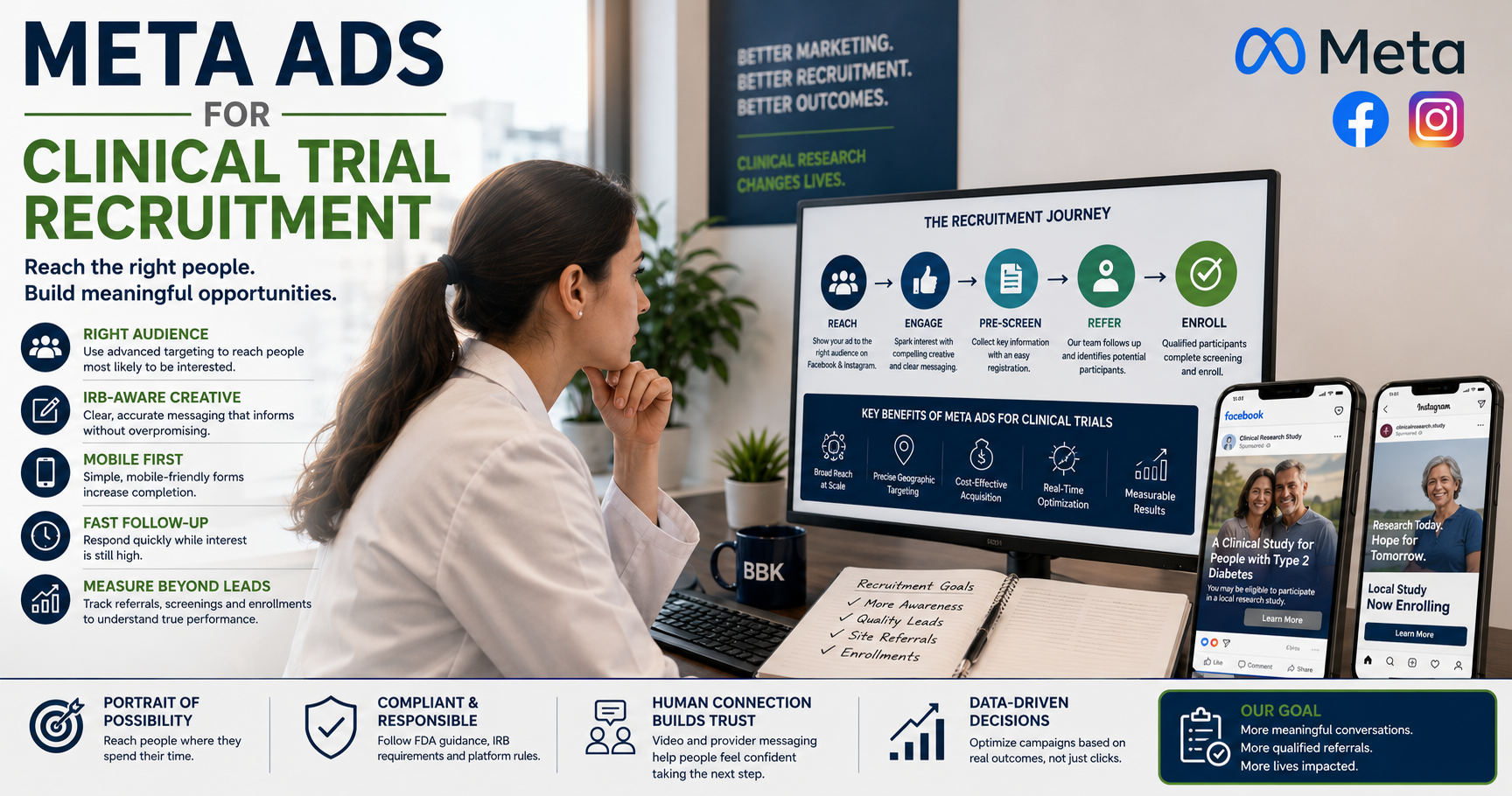
Meta Ads can put a clinical research Study in front of thousands of people within a specific geographic area. That capability makes Facebook and Instagram attractive recruitment channels for Research Sites.
But successful clinical trial recruitment on Meta requires considerably more than launching an advertisement and collecting form submissions. Research organizations need to coordinate Study requirements, audience strategy, geography, recruitment creative, IRB-reviewed materials, Meta advertising requirements, registration, preliminary pre-screening, follow-up, and Site screening.
When these elements work together, Meta can become a powerful participant-recruitment channel. When they do not, a campaign may generate thousands of impressions and hundreds of leads without producing enough meaningful recruitment opportunities.
Why Meta Can Be Valuable for Clinical Trial Recruitment
One of Meta’s biggest advantages is its ability to create awareness. Google Search often reaches someone after they actively search for something. Meta operates differently. A prospective participant may be using Facebook or Instagram without thinking about clinical research at all. An advertisement introduces the opportunity.
That difference matters because many potential participants may never search “clinical trial near me.” But they might respond when they encounter a Study that appears relevant to their situation or to someone in their family. Meta therefore allows recruitment teams to reach people earlier in the participant journey:
Awareness → Interest → Registration → Recruitment
That can create substantial scale, particularly within defined geographic markets. But scale alone is not recruitment success.
Meta Cannot Determine Clinical Trial Eligibility
This distinction should be understood from the beginning. Advertising platforms help identify and reach audiences. They do not determine whether an individual meets a Study protocol.
A Meta campaign may use available audience settings, geography, age parameters where permitted and appropriate, campaign optimization and creative messaging to increase the probability of reaching potentially relevant people. But final Study eligibility involves considerably more information than an advertising platform can know or appropriately evaluate.
That is why digital recruitment should separate audience targeting from preliminary pre-screening from formal Site screening. Each has a different purpose. Meta helps create the opportunity for someone to enter the recruitment process. The Study workflow determines what happens afterward.
Health Information Requires Careful Advertising Strategy
Clinical trial recruitment operates in an unusually sensitive advertising environment because health information is inherently personal. Meta’s U.S. privacy disclosures specifically classify health information as sensitive personal information.
For recruitment marketers, the practical lesson is important: do not build creative that sounds as though the advertising platform knows the viewer’s medical condition.
Compare these approaches. A riskier approach reads, “Do you have uncontrolled asthma?” The wording directly addresses the viewer as though the advertisement knows something about their health. A more neutral recruitment approach reads, “A clinical research Study for people diagnosed with asthma is currently enrolling.” The second version communicates the Study opportunity without framing the advertisement as a personal medical assertion about the person seeing it.
The exact wording still depends on the Study, approved materials and applicable advertising requirements, but the strategic principle is useful: describe the research opportunity rather than making assumptions about the individual viewing the advertisement.
IRB Approval and Meta Approval Are Two Different Things
Research Sites sometimes treat advertising approval as one process. In reality, there can be multiple review layers.
IRB Review. FDA considers direct advertising used to recruit research subjects to be part of the informed-consent and subject-selection process. Recruitment methods and materials should therefore receive appropriate IRB review when required.
Advertising Platform Review. Meta independently evaluates advertisements under its own advertising requirements and systems.
These processes are not interchangeable. An advertisement can be acceptable to an IRB and still encounter a platform-policy issue. Likewise, an advertisement passing platform review does not mean it satisfies the Study’s IRB requirements.
That creates an important operational rule: Research Sites should design recruitment creative with both environments in mind from the beginning. Trying to solve one only after the other rejects the campaign wastes time.
Recruitment Creative Should Be Designed for Both Compliance and Performance
Clinical research advertising has to accomplish two goals simultaneously. It needs to attract attention. And it needs to communicate the Study responsibly.
FDA guidance cautions against recruitment advertising that promises a certainty of cure or favorable outcome and against claims that an investigational drug, biologic or device is safe or effective for the purpose being studied. That immediately eliminates many conventional advertising techniques. Phrases such as “Discover the breakthrough treatment you need” or “Get the newest treatment for your condition” can create serious problems in research recruitment.
A stronger advertisement usually focuses on the research opportunity, the condition being studied, general age criteria when appropriate, location, participation context, and a clear invitation to learn more. The objective is not to create the most sensational advertisement. It is to create an advertisement that attracts appropriate interest.
The Creative Should Help Filter the Audience
Research Sites sometimes try to maximize lead volume by making advertisements very broad. That can produce impressive dashboard numbers. It can also create a large amount of unnecessary work.
For example, imagine a Study requiring participants between ages 50 and 75 at a Site in South Florida. A generic advertisement saying “Clinical Study Now Enrolling — Learn More” may generate responses from a very broad population. Where appropriate and approved, clearer creative can communicate relevant high-level information earlier — for example, “Adults ages 50–75 may be eligible to learn more about a clinical research Study currently enrolling in South Florida.”
Not every person who responds will qualify. But the advertisement provides enough context to help people self-select before entering the funnel. Sometimes this decreases total leads. That can improve recruitment. A campaign should not be judged only by how many people respond. It should be judged by how effectively those responses progress.
Facebook and Instagram Should Not Automatically Use Identical Creative
Meta provides access to multiple placements and experiences. But a creative that works well in one environment may not work equally well everywhere.
Recruitment teams should consider formats such as vertical short-form video, feed video, static images, Stories-style creative, Reels-style creative, and other appropriate placements. This does not mean every Study needs ten different advertisements. It means creative should be designed for the way people actually consume content.
A horizontal clinical-research commercial reduced to a tiny vertical screen may perform differently from a purpose-built mobile video. Likewise, a static graphic overloaded with eligibility criteria can become impossible to read on a phone. Clinical research creative still needs marketing discipline.
Human Presenters Can Play an Important Role
Clinical research often requires trust before action. That makes video particularly interesting. A recruitment video can feature a physician, Principal Investigator, research coordinator, Site representative, patient-recruitment professional, or another appropriate presenter, explaining that the Study exists, who it is generally intended for, where it is taking place, and what someone can do to learn more.
This human element can make an unfamiliar clinical research opportunity feel more understandable. However, presenter choice does not replace good messaging. A physician reading dense protocol language into a camera is not automatically effective advertising. The creative still needs to be clear, concise, credible and participant-oriented. We examine recruitment video strategy separately in Clinical Research Recruitment Videos: Human Presenter, Voice-Over or AI Avatar?
Native Lead Forms Can Reduce Friction
One useful recruitment approach on Meta is allowing someone to express interest without navigating through a complicated external website experience. Reducing steps can improve registration completion.
But convenience creates another responsibility. If it becomes easier to submit a form, the campaign may generate more inquiries with varying levels of relevance. That means the organization should already know what happens immediately after submission. A useful workflow might look like:
Meta Advertisement → Registration → Acknowledgment / Consent Language as Applicable → Initial Recruitment Questions → Preliminary Pre-Screening → Follow-Up → Potential Referral → Site Screening
The advertisement is therefore only the acquisition layer. The recruitment infrastructure behind it determines the real value.
Keep Initial Questions Focused
A Meta form should not become a complete clinical screening examination. The purpose of an early recruitment form is generally to gather enough information to support the next appropriate step. Depending on the approved Study workflow, that may include contact information, age or age range, broad Study-related questions, location, preferred language, and authorization for follow-up.
FDA’s recruitment guidance recognizes that early contact can include questions used to determine basic eligibility while emphasizing appropriate protections for personal and sensitive information.
The guiding principle should be: collect what is necessary for the recruitment stage you are currently performing. Long questionnaires can increase abandonment. Forms that are too short can produce excessive low-relevance inquiries. The correct balance depends on the Study.
Bilingual Campaigns Should Be Built Separately
A Research Site serving English- and Spanish-speaking populations should generally think beyond simply duplicating one campaign and translating the words. The Spanish campaign may require differences in copy, presenter, terminology, pacing, creative, calls to action, follow-up language, and participant expectations.
Most importantly, the recruitment journey should remain consistent after the advertisement. A Spanish-speaking participant should not see a Spanish advertisement, complete a Spanish form, receive an English confirmation, and then receive an English-only call. That is not a bilingual campaign. It is a translated acquisition layer connected to a monolingual recruitment workflow.
This is why localization and operational language capacity matter — covered in depth in English vs Spanish Clinical Trial Campaigns: Why Translation Alone Is Not Enough
Geography Should Be Designed Around Participation, Not Just Cheap Leads
Meta makes geographic advertising convenient. But cheap geography is not automatically productive geography.
Suppose inquiries cost $18 in Area A and $30 in Area B. Area A may initially appear superior. But perhaps Area A is 65 miles from the Research Site while Area B is within 15 miles. If Area B produces more Site screenings and enrollments, its more expensive leads may be substantially more valuable.
Clinical trial recruitment therefore requires geographic analysis beyond advertising cost. Sites should consider reasonable participant travel distance, population size, Site location, visit frequency, transportation, competing Studies, referral conversion, and enrollment performance. The question should not be “Where are leads cheapest?” It should be “Which areas produce useful recruitment opportunities?”
Do Not Optimize Only for Cost Per Lead
Meta provides a large amount of campaign data. That is useful. But the metrics easiest for the platform to report are not necessarily the metrics most important to the Research Site.
A campaign dashboard may show impressions, reach, frequency, clicks, video views, forms, and Cost Per Lead. The Site ultimately cares about contactable inquiries, preliminary pre-screening, referrals, screening, and enrollment. This means a strong recruitment operation needs to connect Meta data with downstream Site outcomes.
Consider two campaigns. Campaign A has a $19 CPL, 200 leads, and 20 potential referrals. Campaign B has a $30 CPL, 120 leads, and 45 potential referrals. The numbers are illustrative. Based on CPL, Campaign A wins. Based on referral productivity, Campaign B may provide much greater recruitment value.
This is why Why Research Sites Should Stop Measuring Recruitment Success by Leads Alone argued that Research Sites should stop measuring recruitment success by leads alone. Meta Ads should be evaluated the same way.
Fast Follow-Up Matters After Meta Registration
Meta users often complete forms while casually browsing. That makes context particularly important. The prospective participant may submit information and immediately return to Facebook, Instagram, messaging, another video, or something completely unrelated. If the Site contacts them days later, the Study may no longer be top of mind.
A strong recruitment workflow can provide immediate acknowledgment explaining that the inquiry was received, which Study or organization it relates to, what happens next, and when contact may occur. Then human follow-up can continue according to the approved recruitment process. As discussed in The Hidden Cost of Slow Follow-Up in Clinical Research Recruitment, slow follow-up can reduce the value of advertising that has already been paid for.
Meta Campaigns Need Ongoing Creative Management
A Study recruiting for several months should not assume that the first successful advertisement will remain effective indefinitely. Performance may change because of audience saturation, creative fatigue, changes in competition, geographic differences, Study recruitment progress, platform changes, or changes in participant response.
Campaign teams should monitor whether frequency rises, click performance deteriorates, form completion changes, referral quality changes, or particular creative repeatedly produces stronger downstream results.
Optimization does not always mean replacing everything. Sometimes a new opening line, presenter, format or visual can refresh performance while maintaining the same approved recruitment concept. Any material modifications should continue to follow the appropriate Study review process.
Build a Library of Approved Creative When Possible
One practical way to make Meta campaigns easier to manage is to plan creative variation before launch. Instead of preparing only one image and one video, consider whether the Study can appropriately have multiple approved headlines, several static visuals, more than one video format, English and Spanish versions, different aspect ratios, and multiple approved calls to action.
This does not mean producing unnecessary assets. It means anticipating that digital advertising requires optimization. FDA guidance specifically notes the value of reviewing advertising wording before final audio or video production, helping avoid unnecessary re-production when wording must change.
For a marketing team, that is an operationally important lesson: IRB-aware creative planning can make digital optimization much easier later.
What Research Sites Should Have Ready Before Launching Meta Ads
Before activating a campaign, a Site should be able to answer: Who are we trying to reach? Which geographic areas are realistic? Which recruitment materials have been approved as required? Which Meta formats will we use? Where will someone register? Which information will we collect? What happens immediately after registration? Who performs follow-up? How quickly can the Site respond? How are potential referrals routed? Which metrics will we track after the lead? How will Site outcomes get back to the marketing team?
If several of those answers are unclear, the organization may not yet have a complete Meta recruitment strategy. It has an advertising plan. Those are not the same thing.
Meta Ads Work Best as Part of a Recruitment System
Meta can provide powerful reach. It can help Research Sites introduce Studies to people who may never actively search for clinical research. It can generate registrations at scale, support geographic campaigns, and provide rapid performance feedback.
But Meta cannot fix poor recruitment messaging, inappropriate creative, confusing forms, weak preliminary pre-screening, slow Site follow-up, inadequate language support, poor referral routing, or missing downstream measurement.
The best Meta recruitment campaigns therefore operate inside a larger system:
Study → Audience → Geography → IRB-Aware Creative → Meta Advertising → Registration → Pre-Screening → Follow-Up → Referral → Site Screening → Enrollment
When Research Sites understand that system, Meta stops being simply a source of Facebook or Instagram leads. It becomes one component of a measurable clinical trial participant recruitment strategy.
Related Reading
- Clinical Trial Patient Recruitment: From Advertising Clicks to Real Participant Opportunities
- Why Research Sites Should Stop Measuring Recruitment Success by Leads Alone
- How to Build a Digital Recruitment Strategy for a Clinical Research Study
- English vs Spanish Clinical Trial Campaigns: Why Translation Alone Is Not Enough
- The Hidden Cost of Slow Follow-Up in Clinical Research Recruitment
- What Is Clinical Research Marketing? A Practical Guide for Research Sites and CROs
- Geographic Targeting for Clinical Trial Recruitment: How Far Should a Campaign Reach?
- Preparing Recruitment Materials for IRB Review: A Practical Guide for Marketing Teams
Frequently Asked Questions
Can Research Sites use Meta Ads for clinical trial recruitment?
Yes, clinical research organizations can use digital advertising for recruitment, subject to applicable Study requirements, IRB review where required and the advertising platform’s current rules. FDA recognizes direct advertising as a legitimate recruitment method while treating it as part of the subject-selection and informed-consent process.
Are Facebook leads the same as qualified clinical trial participants?
No. A Meta lead generally means someone expressed interest or submitted information. Additional recruitment and Site screening steps are required before Study eligibility can be determined.
Should Meta clinical trial ads mention the medical condition?
Recruitment advertisements commonly identify the condition under study, and FDA guidance lists the condition or purpose of the research among information that may appropriately appear in recruitment advertising. Messaging should still avoid inappropriate personal assumptions and comply with current platform and Study requirements.
Should clinical trial recruitment campaigns use Meta lead forms or landing pages?
Either can be appropriate. The best option depends on the Study, recruitment questions, consent requirements, participant experience, tracking needs and operational workflow. The important issue is what happens after registration.
What is the most important Meta Ads metric for clinical trial recruitment?
There is no single metric. CPL can measure acquisition efficiency, but Research Sites should connect advertising data to contact, preliminary pre-screening, referrals, Site screening and enrollment whenever possible.