
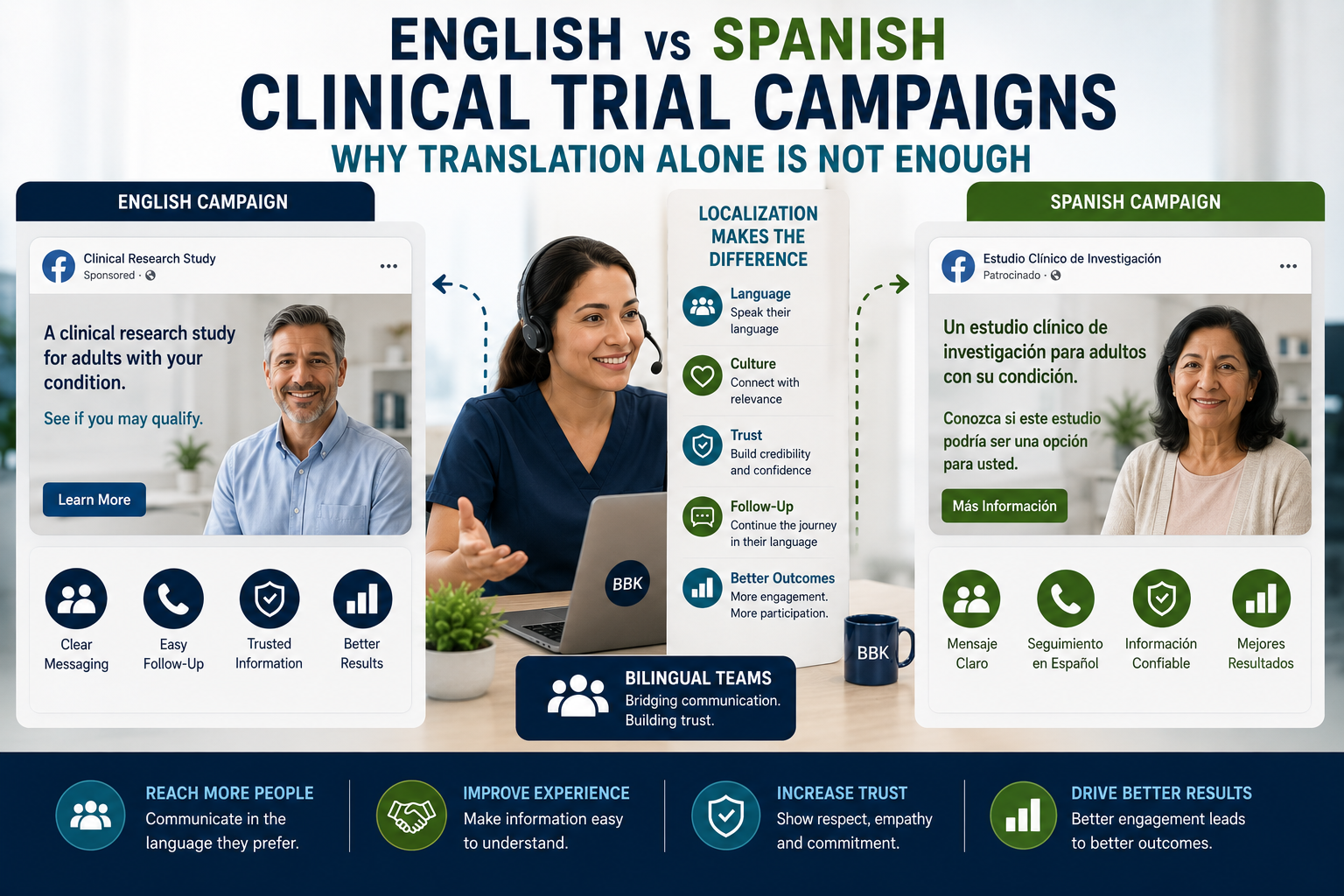
A Research Site launches a clinical trial recruitment campaign in English. The campaign performs well. The team decides to reach Spanish-speaking participants.
The obvious next step seems simple: translate the advertisement into Spanish.
That is necessary. But it is not enough.
An effective Spanish-language recruitment campaign is not simply an English campaign with different words. Language affects how people interpret the Study, how natural the message feels, whether terminology is understood, whether the organization appears trustworthy, how prospective participants interact with the Research Site, and whether the experience remains consistent after the advertisement.
Clinical research organizations that treat Spanish recruitment as a translation project may successfully generate clicks while creating problems deeper in the participant journey. A stronger approach is localization.
Translation and Localization Are Not the Same Thing
Translation answers: “How do we say this in Spanish?”
Localization asks: “How should we communicate this idea naturally and appropriately to this audience?”
The difference can be substantial. A technically correct translation may still feel unnatural, overly formal, confusing, culturally disconnected, too literal, or obviously translated from English. This matters in clinical research because prospective participants are already being asked to consider something unfamiliar. The recruitment message should reduce uncertainty rather than add to it.
ResearchMatch confronted this issue when adapting its national research-participation platform for Spanish-speaking users. Instead of simply sending the English website through a translation process, the team first simplified English content, removed jargon and improved readability. It then used professional translation followed by iterative review from bilingual community members representing different Hispanic backgrounds.
That process illustrates an important principle: good localization begins before translation. If the original English message is complicated, technical or unclear, translating it does not solve the communication problem. It simply reproduces the problem in another language.
Spanish-Speaking Audiences Are Not One Homogeneous Population
Another mistake is assuming that there is one universal “Hispanic audience.” Spanish-speaking populations in the United States come from many backgrounds, including Mexico, Puerto Rico, Cuba, Central America, South America, the Dominican Republic, Spain, and other regions.
Vocabulary, tone and cultural expectations can vary. A word that sounds completely natural to a Cuban audience may sound unusual to someone from Mexico. Another phrase may be understood everywhere but feel unnecessarily formal.
Research into the Spanish adaptation of ResearchMatch specifically recognized linguistic and cultural diversity across U.S. Hispanic populations rather than assuming one background represented everyone.
That does not mean every clinical trial needs twenty Spanish versions. It means marketers should avoid unnecessary regional slang and use language that is clear, broadly understandable and appropriate for the communities being recruited.
Start With Plain Language
Clinical research already contains difficult terminology, including investigational product, inclusion criteria, exclusion criteria, screening visit, placebo, randomization, informed consent, protocol, and research participant. Even English-speaking audiences may not immediately understand these terms. Literal Spanish translations can make them even harder.
OHRP guidance emphasizes that informed-consent communication should use language understandable to the target population and should be culturally sensitive. It also recommends ordinary language instead of technical terminology whenever possible.
The same communication principle is useful much earlier in recruitment. Instead of asking, “What is the technically precise translation?”, also ask, “Will an ordinary person understand what we mean?” Those are not always the same question.
The Advertisement Should Sound as Though It Was Written in Spanish
One of the easiest ways to recognize weak localization is sentence structure. A translated advertisement may be grammatically correct but preserve English syntax so closely that it feels artificial.
For example, marketers sometimes translate “See if you may qualify” into a phrase that is technically accurate but unnatural in everyday Spanish. A more appropriate recruitment expression might communicate: “Conozca si este estudio podría ser una opción para usted.”
The exact wording depends on the Study and approved materials. The point is not that one phrase is universally correct. The point is that meaning should lead the translation — not word order.
Cultural Relevance Does Not Mean Stereotyping
Localization can easily be misunderstood. It does not mean putting flags everywhere, automatically showing a stereotypical Hispanic family, using excessive cultural symbols, assuming all Spanish speakers share the same values, or artificially adding slang. That can make creative feel less authentic, not more.
Cultural relevance is often more subtle. It may involve family involvement, communication style, trust, who delivers the message, community context, preferred language, and how unfamiliar research concepts are explained.
A 2024 study involving older Hispanic/Latino adults identified language barriers, limited knowledge of clinical trials and institutional mistrust among participation barriers. Participants recommended culturally tailored materials and staff, family involvement and community-oriented outreach.
Effective localization therefore means understanding how the intended population experiences the recruitment process.
Trust Matters Before Translation Matters
A perfect translation cannot overcome a complete lack of trust. Research involving Spanish-speaking and Latino populations repeatedly identifies trust as a central recruitment issue.
A study examining recruitment of midlife Latinas noted that lack of accurate Spanish-language information and mistrust can create barriers to research participation. The investigators used a predominantly bilingual team drawn from the communities being recruited and emphasized direct communication with prospective participants.
Another review of Spanish-speaking Latinx recruitment strategies highlighted the importance of building confianza, understanding the target community and maintaining visible relationships with recruitment partners.
For marketing teams, this has practical consequences. The question should not simply be, “Is the advertisement in Spanish?” It should also be: Who appears in the advertisement? Does the Site feel credible? Will someone answer in Spanish? Will the participant feel understood once they respond?
A Spanish Advertisement Requires a Spanish Recruitment Journey
This may be the biggest operational mistake in bilingual campaigns.
Spanish Ad → Spanish Lead Form → English Confirmation → English Phone Call → English Site Coordinator
The acquisition campaign is technically bilingual. The recruitment system is not. That disconnect can damage trust immediately.
Imagine responding to a Spanish advertisement because it is easier for you to communicate in Spanish. You submit your information. Then someone calls and begins speaking English. The message the participant receives is clear: the organization was willing to advertise to me in Spanish, but may not actually be prepared to communicate with me in Spanish.
This is not primarily a translation issue. It is an operational issue.
Bilingual Staff Can Influence Recruitment
Research supports the importance of language-capable personnel. A study examining Spanish-speaking Latino recruitment into outpatient clinical treatment trials in Northern California found that a Spanish/English bilingual recruiter was critical to the recruitment model. The investigators also highlighted the timely availability of Spanish recruitment materials, consent materials and interviews.
A scoping review examining recruitment of older Hispanic/Latinx adults similarly identified bilingual research staff and Spanish-language educational materials as recurring strategies used to overcome language barriers.
The implication for Research Sites is direct: if you advertise in Spanish, someone in the recruitment workflow should be capable of continuing the conversation in Spanish. That person might be a research coordinator, recruitment specialist, investigator, centralized recruitment team member, or another appropriately trained individual. The organizational structure can vary. The continuity should not.
Spanish Materials Should Be Available at the Right Time
Another mistake is waiting until Spanish-speaking inquiries begin arriving before preparing the necessary materials. By then, the recruitment campaign has already created demand the Site may not be ready to serve.
A stronger workflow prepares relevant language assets before launch, including advertising creative, video scripts, landing pages, Meta forms, preliminary pre-screening questions, acknowledgment messages, telephone scripts, email communication, SMS content, Study information, and consent-related materials when applicable.
OHRP guidance states that when prospective subjects do not speak English, the consent process should provide information in a language understandable to them, and it strongly encourages written consent documentation in that language when possible.
That is later in the research process than advertising, but it demonstrates the broader expectation: language accessibility should continue throughout participation — not end when the advertisement generates a lead.
Do Not Translate Creative at the Last Minute
A common workflow looks like this: create an English campaign, receive approval, decide to run Spanish, translate everything quickly, discover that layouts no longer fit, discover that video pacing does not work, resubmit materials, and delay the campaign launch.
Spanish content should ideally be considered during creative planning. Why? Because languages occupy space differently. A headline that fits comfortably in English may be substantially longer in Spanish. A 20-second English voice-over may require more time when translated naturally. On-screen text may need to be rearranged. Subtitles may become difficult to read. Calls to action may not fit.
Creative localization therefore affects design as well as words.
Video Requires More Than Spanish Audio
Video adds another layer. Suppose an English recruitment video contains an English-speaking physician, English signs in the background, English graphics, English captions, and English text on a tablet. Replacing the audio with Spanish does not necessarily create a Spanish campaign. The result can feel dubbed rather than localized.
A stronger Spanish version may require a Spanish-speaking presenter, localized on-screen text, redesigned graphics, Spanish captions, adjusted timing, and possibly different supporting visuals. Whether all of those changes are necessary depends on the creative, but the team should at least evaluate them.
The Presenter Matters
Human presenters can be particularly useful in bilingual recruitment because they communicate more than language. A Spanish-speaking physician or coordinator can demonstrate that the organization is genuinely prepared to interact with Spanish-speaking participants.
This does not mean the presenter must share the participant’s nationality. Nor should ethnic appearance be treated as a substitute for language ability. What matters is authentic communication. A presenter who speaks natural Spanish can provide clarity, familiarity, confidence, and a visible connection between the advertisement and the research organization.
This is one reason bilingual capability should be considered during recruitment creative development rather than after the campaign is already built.
Literal Translation Can Distort Calls to Action
Calls to action are particularly sensitive to translation. English digital marketing frequently uses expressions such as “Learn More,” “See If You Qualify,” “Sign Up,” “Apply Now,” and “Get Started.” Not all of them translate naturally or appropriately into a clinical research context. A literal version may sound too commercial, too definitive, unnatural, or stronger than the Study workflow actually supports.
For clinical trial recruitment, the CTA should reflect what happens next. Examples might include concepts such as “Learn more about the Study,” “Complete a brief registration form,” or “See whether this research opportunity may be relevant.” The wording should match the approved recruitment process.
Localization therefore requires both language judgment and operational understanding.
Spanish Campaigns May Need Different Creative
A bilingual strategy should not assume the same image or video will perform identically in both languages. There are legitimate reasons to test an English Creative A against a genuinely built Spanish Creative B rather than simply an English Creative A against a Spanish translation of that same creative.
Different audiences may respond differently to presenter, visual environment, message structure, pacing, emphasis, amount of information, family context, and tone. The objective is not to manufacture cultural differences. It is to recognize that localization provides an opportunity to design communication around the intended audience rather than forcing one campaign into two languages.
Measure English and Spanish Campaigns Separately
Combining both campaigns into one performance report can hide important information. A Research Site should ideally be able to compare each language’s spend, inquiries, Cost Per Lead, pre-screen completion, referrals, Site screening and enrollment on its own.
The goal is not to declare one language “better.” The goal is to identify where each recruitment pathway behaves differently. Spanish ads might produce a higher CPL but stronger referral progression, or the opposite. One language might experience a larger drop after registration. Another might produce excellent inquiries but weaker Site contact because bilingual coverage is limited. Without separate measurement, those operational differences disappear inside averages.
Do Not Assume Lower Digital Metrics Mean Lower Value
Suppose an English campaign shows a $22 CPL and a Spanish campaign shows a $31 CPL. It would be easy to reduce the Spanish budget.
But imagine downstream performance: the English campaign converts 100 leads into 20 referrals, while the Spanish campaign converts 70 leads into 30 referrals. The numbers are hypothetical. The point is that recruitment should again be measured beyond the initial advertising metric.
A bilingual campaign is not successful because it generates cheap Spanish leads. It is successful when Spanish-speaking prospective participants can progress through the recruitment process effectively.
Localization Also Applies to Forms
Recruitment forms need particular attention. Questions should be translated for meaning, not word-by-word equivalence. Terminology involving diagnoses, medications, caregivers, prior treatment, age, physician relationships, and contact consent needs to be understandable to an ordinary participant. This is especially important for populations with varying literacy levels.
The ResearchMatch Spanish project specifically began by improving plain language and reading level before translation, while OHRP similarly encourages understandable language instead of unnecessary technical vocabulary. That is a useful design principle: if a question is difficult to understand in English, translation will not rescue it. Fix the source content first.
Consider Family and Caregiver Roles
Some recruitment campaigns naturally involve family members — for example, pediatric Studies, Alzheimer’s disease, dementia, certain neurological conditions, older adults requiring assistance, and other Studies where caregivers play an important role.
Research involving older Hispanic/Latino adults found participants emphasized family support and reliance on adult children in decision-making, transportation and interpretation.
That does not mean every Spanish recruitment campaign should target families. But when the Study population depends on caregivers, the creative should consider who is actually making the decision to respond: the participant, the parent, the spouse, or an adult child. Recruitment language should speak appropriately to the person most likely to take that first action.
Geography Can Influence Localization
Spanish recruitment in Miami may not look exactly like Spanish recruitment in Los Angeles, Houston, New York, Puerto Rico, Arizona, or Central Florida. The language may remain broadly understandable, but local population composition and community context can influence creative, community partnerships, media channels, presenter selection, and messaging.
This is another reason why the term Hispanic recruitment should not be treated as one uniform marketing segment.
Bilingual Recruitment Can Expand Access
The business case for bilingual recruitment matters. But there is also a participant-access issue. If a Study theoretically accepts Spanish-speaking individuals but all recruitment happens only in English, many eligible people may never discover the opportunity. If the advertising exists in Spanish but later stages cannot support the participant, access is only partially improved.
Research on Spanish-language clinical trials consistently identifies language accessibility, bilingual staffing and culturally appropriate recruitment as meaningful components of participation. A strong bilingual recruitment system therefore expands more than advertising reach. It expands the number of people who can realistically navigate the recruitment process.
Translation Is a Production Task. Localization Is a Strategy.
This is the central distinction. Translation changes language. Localization considers language, audience, culture, trust, creative, recruitment workflow, and Site capability.
The difference can determine whether Spanish-speaking prospective participants experience a translated advertisement or a recruitment process actually designed to include them.
Research Sites should therefore stop asking only, “Do we have the Spanish version?” The better questions are: Does this sound natural in Spanish? Will the target community understand it? Does the creative fit the audience? Can someone continue the conversation in Spanish? Are forms and participant communications localized? Does the Site have bilingual capacity? Are Spanish campaign outcomes measured separately?
When those answers are yes, bilingual clinical research marketing moves beyond translation. It becomes a genuine Spanish clinical trial recruitment strategy.
Related Reading
- Meta Ads for Clinical Trial Recruitment: What Research Sites Need to Know
- Clinical Research Recruitment Videos: Human Presenter, Voice-Over or AI Avatar?
- Why Participant Experience Matters Before the First Research Site Call
- Preparing Recruitment Materials for IRB Review: A Practical Guide for Marketing Teams
- Translation vs Localization in Clinical Trial Advertising
Frequently Asked Questions
What is the difference between translation and localization in clinical trial recruitment?
Translation converts content from one language to another. Localization adapts the message, terminology, tone, visuals and recruitment experience so that communication is appropriate and understandable for the intended audience.
Should clinical trial advertisements be available in Spanish?
When a Study intends to recruit Spanish-speaking participants, Spanish-language recruitment materials can improve accessibility. The appropriate materials and approval process depend on the Study and its IRB requirements.
Does a Spanish clinical trial campaign need bilingual staff?
A complete bilingual recruitment workflow should provide a practical way for Spanish-speaking prospective participants to continue communicating in Spanish after responding. This may involve bilingual Site staff, recruiters or other appropriately trained personnel.
Can the same clinical trial advertisement simply be translated into Spanish?
It can serve as a starting point, but the translated version should be reviewed for natural language, cultural relevance, visual layout, terminology and consistency with the rest of the recruitment journey.
Should English and Spanish recruitment campaigns be measured separately?
Yes, when practical. Separate reporting can identify differences in acquisition cost, pre-screen completion, referral progression, Site screening and enrollment and can reveal operational barriers that aggregated reporting might hide.