
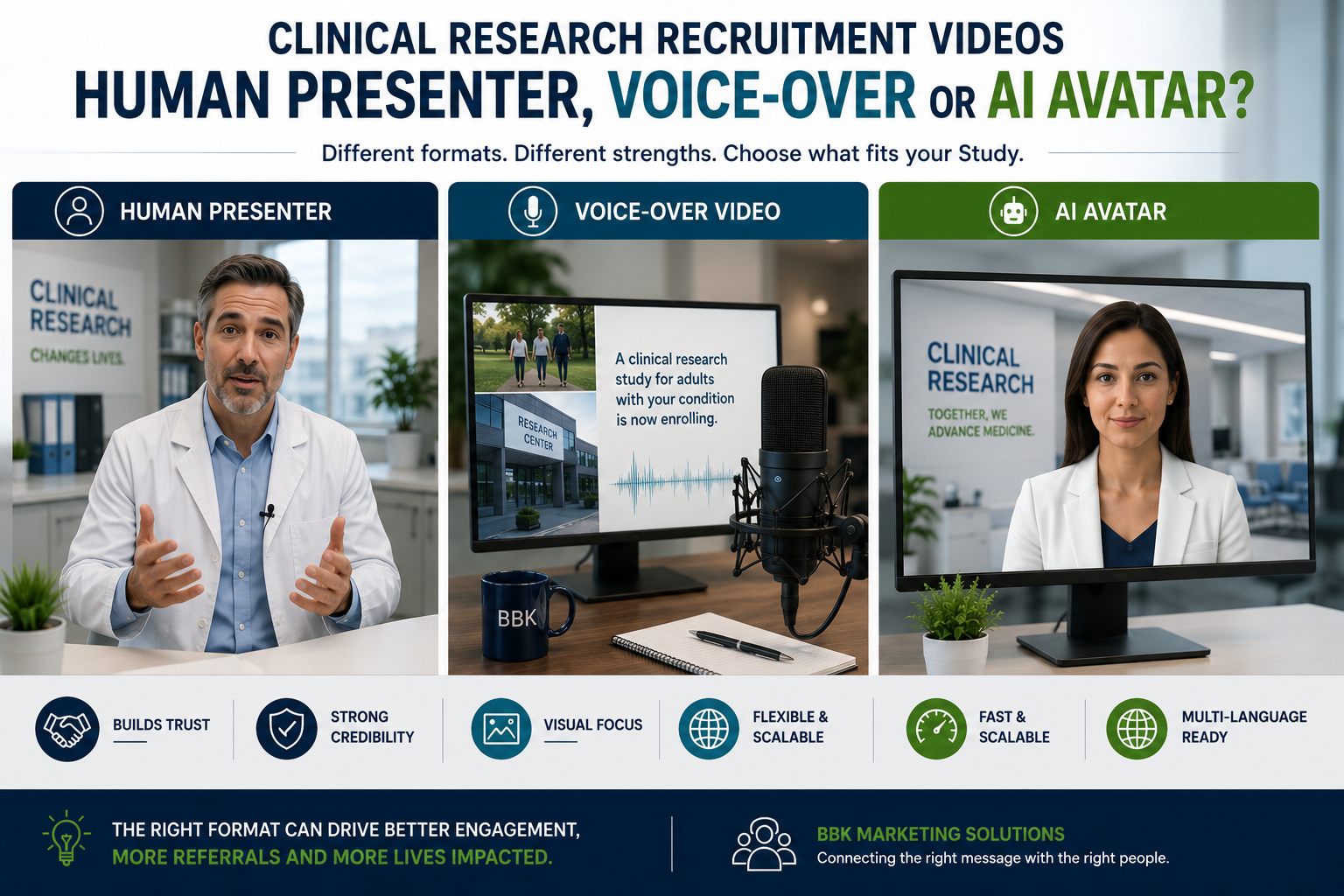
Video has become one of the most versatile creative formats available to clinical trial recruitment teams. A Research Site can use video to introduce a Study, explain a recruitment opportunity, communicate with caregivers, support bilingual campaigns, or simply make a clinical research advertisement feel more understandable.
But producing the video creates another decision: who — or what — should deliver the message?
A Research Site might use a real physician, a research coordinator, another human presenter, a voice-over with visual content, or an AI-generated avatar. All of these formats can produce professional recruitment creative. They do not, however, create exactly the same participant experience.
The appropriate choice depends on the Study, target population, message, budget, production requirements, desired level of human connection and ability to maintain the creative over time. There is no universal winner. The more useful question is: which presentation format best fits this recruitment situation?
Why Video Matters in Clinical Trial Recruitment
Clinical research can be unfamiliar. Someone encountering a Study advertisement may immediately have questions: What is this Study? Why is it being conducted? Who is it intended for? Where is the Research Site? What happens if I respond? Is this legitimate? Will someone call me? Does responding mean I have agreed to participate?
Static advertising has limited space to answer those questions. Video provides more room to build context. A presenter can communicate tone, pacing and reassurance while visuals reinforce the Study information. Video can also be adapted across Facebook, Instagram, landing pages, Research Site websites, email, digital recruitment campaigns, and other participant-facing environments.
Social media itself has demonstrated potential as a clinical-trial recruitment channel, although recruitment and enrollment performance varies considerably between Studies and methods. A scoping review of 33 clinical trials found substantial variation in outcomes and emphasized the need to measure recruitment and enrollment consistently rather than assuming one digital approach will perform best everywhere. The same principle should apply to video creative.
Option 1: The Human Presenter
A human presenter is the most direct format. The person appears on camera and speaks to the prospective participant. Possible presenters include a Principal Investigator, physician, research coordinator, Site representative, professional spokesperson, or another approved individual.
The major advantage is straightforward: there is a real person delivering the message. For an unfamiliar clinical research opportunity, that can provide context that text and graphics alone cannot. The viewer sees facial expressions, body language, speaking style, tone, and a recognizable human presence. That does not automatically create trust, but it provides the raw materials from which interpersonal trust can develop.
When a Physician Can Be Particularly Effective
A physician can provide immediate contextual credibility. If viewers understand that the person speaking is connected with the Study or Research Site, the message may feel less like conventional advertising and more like an introduction to a legitimate research opportunity. A physician might say, “Our research team is currently enrolling adults for a clinical Study evaluating an investigational approach for…” That message has a different character from a generic advertising voice.
However, using a physician also creates responsibilities. The presenter should not overstate potential benefits, imply that participation is medically recommended for the viewer, make unsupported safety or efficacy claims, or use professional authority to pressure participation. The physician’s role should support clarity and credibility, not create an implied guarantee.
The Human Presenter Has Production Limitations
Human video is not automatically easy to produce. Common challenges include scheduling, lighting, location, audio quality, presenter comfort, multiple takes, script changes, bilingual production, and the need to record again when important content changes.
A physician may be excellent clinically and still appear uncomfortable on camera. A professional presenter may communicate naturally but lack the inherent Study connection of actual Site personnel. The recruitment team therefore needs to evaluate both who is credible and who communicates effectively on video. Those are not always the same person.
Option 2: Voice-Over Recruitment Video
Voice-over occupies an interesting middle ground. No presenter appears continuously on screen. Instead, the participant hears narration while viewing Study-related graphics, Research Site footage, participant-friendly illustrations, lifestyle scenes, text, simple animations, or other approved visual material.
This format can be extremely effective when the message itself matters more than the identity of the speaker.
Production Flexibility — visuals can often be changed without recording the entire presentation again.
Consistency — a professional narrator can maintain controlled pacing and pronunciation.
Visual Focus — the viewer’s attention can remain on Study information rather than on a spokesperson.
Localization — different language tracks can sometimes be produced while preserving much of the visual structure.
Lower Production Complexity — the Site may not need to coordinate physician availability or an on-camera production session.
For some campaigns, these advantages outweigh the absence of an on-camera human face.
Where Voice-Over Can Feel Less Personal
The limitation is the reverse of its strength. Because there may be no visible person communicating directly with the audience, the video can feel more institutional. That may work well for informational content, explainer videos, straightforward recruitment messaging, or campaigns where the visuals themselves carry much of the message.
But for a Study requiring a stronger sense of interpersonal reassurance, voice-over alone may offer less human connection than an on-camera presenter. This is especially relevant when the audience may already feel uncertain about clinical research.
Option 3: AI Avatar
AI avatars have fundamentally changed the economics of video production. A marketing team can now create a humanlike presenter without organizing a traditional recording session. The technology can potentially provide fast production, multiple languages, consistent delivery, easy script updates, multiple presenter options, scalable creative variations, and reduced dependency on physical production.
For recruitment organizations managing many Studies or multiple geographic markets, that can be operationally attractive. But efficiency is not the only consideration. Clinical research communication involves trust, and that makes avatar choice more complicated.
AI Avatars Are Not Automatically Untrustworthy
It would be inaccurate to assume that audiences always reject AI-generated presenters. Recent healthcare research illustrates why. A 2025 Mayo Clinic pilot study evaluated an AI-generated avatar representing a surgeon for postoperative patient education. Thirty patients interacted with the avatar, and the study reported high usability, engagement and trust; all participants rated the avatar’s information as trustworthy and believable.
That is significant. It demonstrates that a well-designed AI avatar can work in a healthcare communication environment. But the context matters. The avatar represented a physician the participants knew, and it delivered predetermined postoperative educational information. That is different from a stranger encountering a cold recruitment advertisement on social media. We should therefore avoid transferring the result automatically to clinical trial advertising.
AI Avatars Can Also Weaken Persuasion
Other research points in the opposite direction. A 2026 experimental study involving 211 participants compared human communicators with AI-powered digital avatars in cancer-screening messages. The researchers found lower behavioral intentions after messages delivered by the avatar compared with the real human communicator. They also found that the effect was more pronounced when the avatar represented a high-expertise identity such as a doctor.
The proposed explanation involved perceived communicative responsibility. People may interpret a real human speaker as personally standing behind a health-related message in a way that a digital representation does not.
For clinical research recruitment, that finding deserves attention. A hyperrealistic AI doctor might appear technologically impressive while simultaneously creating uncertainty: Is this a real physician? Is this person actually connected to the Study? Who is responsible for this message? Those questions can affect how the creative feels.
The Context Determines the Value of the Avatar
These apparently conflicting findings do not mean the research is useless. They tell us something more valuable: the format cannot be evaluated independently from the context.
An AI avatar might work very well when the audience already knows the organization, the purpose is informational, the identity of the speaker is transparent, frequent updates are necessary, many language versions are needed, or the avatar represents an actual known professional with appropriate disclosure.
It may be less suitable when the campaign depends heavily on personal credibility, the audience has little familiarity with clinical research, the avatar could be mistaken for a real Study physician, emotional reassurance is central, or the creative tries too hard to simulate authentic human testimony.
AI should solve a communication problem. It should not be used simply because it is new.
Disclosure and Authenticity Matter
If a synthetic presenter could reasonably be mistaken for an actual physician, patient, investigator or Study representative, transparency becomes especially important. The recruitment team should avoid creating false impressions about who the person is, whether they actually work at the Site, whether they participated in the Study, whether they are giving a testimonial, or whether they are a real physician associated with the research.
This matters beyond technology. Clinical research advertising depends on accurate participant expectations. A beautifully produced video that creates the wrong impression is not strong recruitment creative.
Human Presenter vs AI Avatar Is Not Just a Technology Question
At first glance, the comparison seems to be traditional production vs artificial intelligence. The deeper comparison is authentic interpersonal presence vs scalable synthetic communication.
Human presenters typically offer natural expression, genuine human presence, easier association with a real organization, spontaneous nuance, and potentially stronger interpersonal credibility. AI avatars typically offer rapid production, lower logistical complexity, easier updates, consistent delivery, language scalability, and potentially lower marginal production cost. Neither list determines performance. It describes trade-offs.
Voice-Over Remains an Underestimated Option
The excitement around AI can create a false binary: human presenter or AI avatar. Voice-over deserves to remain in the discussion. In many recruitment campaigns, the organization may not need a visible synthetic presenter at all.
A well-produced voice-over video using real Site footage, participant-friendly graphics, location imagery, Study information, and appropriate human scenes can feel authentic without requiring someone to speak directly to camera. This can be especially useful when a Site wants production efficiency without creating questions about whether an avatar represents a real Study professional.
Consider the Audience
Different populations may respond differently to presentation formats. Important variables can include age, digital familiarity, language, cultural expectations, therapeutic area, prior clinical research experience, and comfort with AI.
A technology-focused audience may view synthetic video as normal. Another audience may find it impersonal. Older participants may respond differently from younger digital-native populations. Caregivers may have different expectations from direct participants. There should therefore be no assumption that one creative format applies equally to every Study.
Consider the Therapeutic Area
The nature of the Study can also influence the creative decision. A relatively straightforward Study may work well with voice-over, animation, or simple video.
A Study involving significant uncertainty, caregivers, cognitive impairment, serious illness, pediatric participation, or emotionally sensitive conditions may benefit from additional human presence. That does not automatically mean a physician needs to appear. It means the emotional and communication requirements of the Study should influence creative format.
Consider the Funnel Stage
A format appropriate for initial awareness may not be ideal later in recruitment. For example, a short AI-assisted video might efficiently introduce the Study at the Awareness Advertisement stage. On the Landing Page, a real Site representative could explain the opportunity. After Registration, a pre-recorded physician video could explain what happens next. For an Appointment Reminder, automated video or audio communication might be sufficient.
This leads to an important insight: Research Sites do not necessarily need to choose one video format for the entire participant journey. Different formats can perform different jobs.
Production Cost Should Not Be the Only Decision
AI avatars can reduce production barriers. That matters. But recruitment organizations should avoid making the decision exclusively around which option is cheapest. The real economic question is which format produces the best recruitment value.
Imagine Video A costs $300 to produce, generates 200 leads and 15 referrals, while Video B costs $1,500 to produce, generates 150 leads and 40 referrals. The numbers are hypothetical. The cheaper video generated more leads. The more expensive video generated substantially more referrals. Which one was actually cheaper?
This is why creative performance should eventually be measured beyond production cost and CPL.
Measure the Right Outcomes
Recruitment videos can be evaluated at several levels.
Creative-Level Metrics — video views, 3-second views, completion rate, watch time, click-through rate.
Acquisition Metrics — registrations, conversion rate, Cost Per Lead.
Recruitment Metrics — pre-screen completion, potential referrals, Cost Per Referral, Site screening, enrollment.
A video could generate excellent watch time and still produce poor recruitment. Another could receive fewer views but attract a more relevant audience. The objective is not to produce the most entertaining clinical research video. It is to support the recruitment objective.
Test Formats When the Study Allows It
If creative approvals and budget allow, Research Sites may benefit from testing presentation formats rather than making assumptions. For example: Version A with a real Site representative, Version B with voice-over, and Version C with an AI avatar. Keep major recruitment messaging consistent where possible, then compare engagement, Cost Per Lead, pre-screen progression, referrals, and downstream Site outcomes.
This produces Study-specific evidence. That matters because published evidence on social-media recruitment already demonstrates substantial variability between Studies and recruitment approaches. The creative format that wins for one Study may not win for another.
When I Would Choose Each Format
Choose a Human Presenter When trust and personal connection are especially important, a credible Site professional is available, the Study needs human reassurance, the presenter communicates naturally, or the organization wants viewers to meet the real people behind the research.
Choose Voice-Over When information and visuals matter more than presenter identity, production flexibility is important, multiple visuals need to explain the Study, or the organization wants scalable professional video without a synthetic spokesperson.
Choose an AI Avatar When rapid production is important, many versions or languages are needed, scripts change frequently, the use of a synthetic presenter is transparent, and the Study context does not depend heavily on perceived personal authenticity.
Consider a Hybrid Approach When a real physician introduces the Study, graphics explain key information, voice-over covers supporting content, and AI assists with production or localization.
Often, the strongest solution will not be ideological. It will be practical.
AI Should Enhance Recruitment Creative, Not Define It
The arrival of generative AI creates powerful new production options. Research Sites can produce content faster than ever. But speed should not become the creative strategy.
Whether the speaker is a physician, coordinator, professional presenter, narrator, or AI avatar, the recruitment video still has to answer the same questions: Is the message clear? Is it accurate? Does it create appropriate expectations? Does it feel credible? Does it speak to the intended audience? Does the participant understand what to do next? Does it ultimately contribute to meaningful recruitment outcomes?
Technology changes the production method. It does not change the fundamental purpose of recruitment communication.
Related Reading
- What Makes Clinical Research Marketing Different From Traditional Healthcare Marketing?
- How to Build a Digital Recruitment Strategy for a Clinical Research Study
- English vs Spanish Clinical Trial Campaigns: Why Translation Alone Is Not Enough
- Meta Ads for Clinical Trial Recruitment: What Research Sites Need to Know
- Preparing Recruitment Materials for IRB Review: A Practical Guide for Marketing Teams
- Translation vs Localization in Clinical Trial Advertising
Frequently Asked Questions
Are AI avatars appropriate for clinical trial recruitment videos?
They can be, depending on the Study, audience, message and manner of use. AI avatars offer production and localization advantages, but recruitment teams should consider transparency, credibility and whether a synthetic presenter fits the communication needs of the Study.
Are human presenters more trustworthy than AI avatars?
There is no universal rule. Some health-communication research has found stronger behavioral responses to human communicators, while other healthcare studies have reported high trust and acceptance of carefully designed AI physician avatars. Context is important.
Should a physician appear in a clinical trial recruitment video?
A physician can provide credibility and human context, but it is not mandatory. The presenter should communicate naturally, follow approved messaging and avoid creating inappropriate expectations about participation or benefit.
Is voice-over still useful now that AI avatars are available?
Yes. Voice-over remains a flexible option for recruitment videos that rely on Site footage, graphics, Study information or participant-focused visuals without requiring an on-camera presenter.
How should Research Sites compare recruitment videos?
Sites should look beyond views and engagement. When possible, compare registrations, pre-screen completion, referral quality, Cost Per Referral, Site screening and enrollment by creative source.