
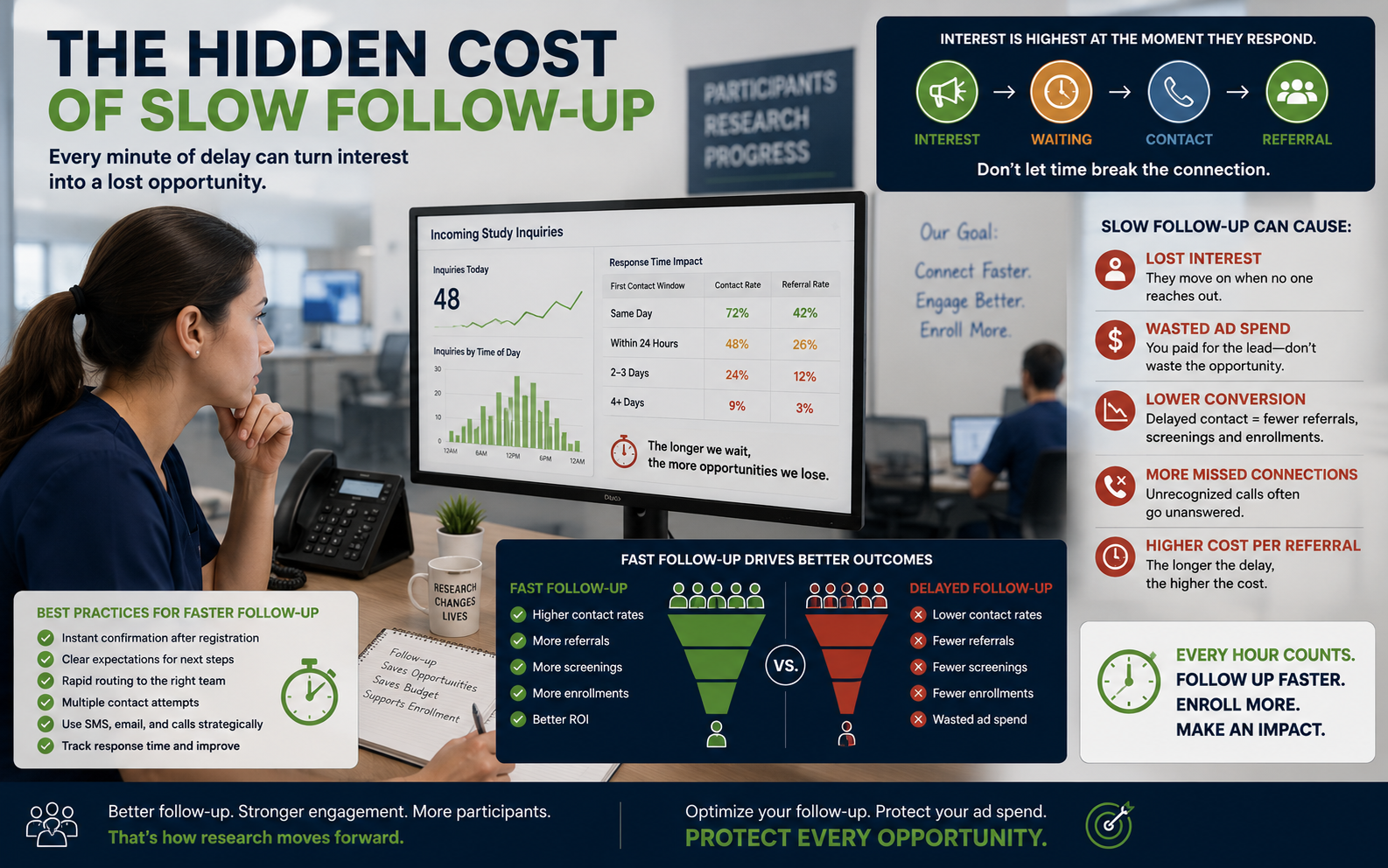
A prospective participant sees a clinical trial advertisement at 9:17 p.m. The Study appears relevant. They complete the registration form. They answer several preliminary questions. Then nothing happens.
No confirmation. No explanation. No message telling them who will contact them.
The Research Site calls two days later from a number they do not recognize. The call goes unanswered.
From an advertising perspective, the campaign worked. From a recruitment perspective, the opportunity may already be disappearing.
This is the hidden cost of slow follow-up. Clinical research organizations often spend significant time optimizing audiences, advertising creative, Cost Per Lead and recruitment budgets while paying less attention to the period immediately after someone raises their hand. But that period matters. The gap between participant interest and meaningful human contact can determine whether an advertising response becomes a viable recruitment opportunity or another lead marked “Unable to Contact.”
Advertising Creates a Moment of Interest
Digital recruitment has an important characteristic: people respond when it is convenient for them. That may be during lunch, late at night, before work, on a Saturday, during a holiday, or while browsing social media from home. Research Sites typically do not operate on the same schedule. That creates a structural gap between advertising and recruitment operations.
The moment someone submits a Study form is valuable because the Study is currently relevant enough for that person to act. They have just noticed the advertisement, processed the message, decided the opportunity may apply to them, accepted the idea of learning more, and provided contact information. That sequence represents active interest.
Follow-up should be designed to preserve it.
Slow Follow-Up Has More Than One Cost
When follow-up is delayed, the most obvious consequence is losing potential participants. But the financial and operational consequences are broader. A delayed recruitment workflow can increase Cost Per Contact, Cost Per Referral, staff time, number of contact attempts, advertising waste, funnel abandonment, and the amount of media spend required to achieve the same recruitment objective.
Suppose a campaign produces 200 inquiries. If a Site successfully progresses 30 of them, it may conclude that it needs 400 inquiries to double recruitment output. That could lead directly to doubling advertising spend.
But what if many of the original 170 non-progressing inquiries were lost because of delayed or ineffective follow-up? In that case, the Site may be buying additional leads to compensate for an operational problem. That is why response time should be treated as part of recruitment economics.
A Lead Becomes Less Useful When Context Is Lost
Imagine receiving an unexpected call today from an unfamiliar number. Now imagine receiving the same call after receiving this message: “Thank you for your interest in the clinical research Study. Our research team received your information and may contact you to discuss the next steps.”
The phone call itself has not changed. The context has.
That context matters because prospective research participants may have responded to several advertisements, other clinical Studies, medical services, insurance communications, or unrelated online forms. After enough time passes, they may not remember which organization is calling.
A simple acknowledgment helps connect the advertisement, the registration, and the upcoming contact. It also reassures the individual that the information they submitted actually reached someone.
Communication Problems Are Real Recruitment Barriers
This is not simply a marketing theory. A U.S. clinical research project involving 33 Sites identified communication problems and unreliable contact information among the barriers affecting recruitment and retention. The researchers used barrier analysis to connect those problems with actionable Site-level solutions.
Current NCCIH recruitment guidance likewise recommends systematically tracking potentially eligible individuals, following up with those who have not yet consented, and addressing outstanding questions or concerns that could prevent participation.
The lesson for Research Sites is straightforward: recruitment requires an organized contact process, not simply a list of leads.
Response Time Should Be Measured
Many Sites measure number of leads, number of referrals, number screened, and number enrolled. Far fewer consistently measure how long it took to respond.
That information can reveal important differences. A useful dashboard might track:
- Median First Response Time — time from registration to first outreach.
- Same-Day Contact Rate — percentage of inquiries receiving outreach during the same calendar day.
- Contact Within 24 Hours — percentage receiving an initial contact attempt within 24 hours.
- Time to Successful Contact — time between registration and an actual two-way interaction.
- Contact Attempts Per Successful Contact — how much staff effort is required before the prospective participant responds.
- Response Time by Registration Period — comparing weekday vs weekend, business hours vs after-hours, and morning vs evening.
Patterns may quickly emerge. Perhaps weekday leads perform well while weekend leads disappear. That is not necessarily an advertising problem. It may reveal a recruitment coverage problem.
There Is No Universal “Perfect” Follow-Up Time
Sites should be careful about claims such as “every clinical-trial lead must be called within five minutes.” Clinical research is not ordinary consumer sales. The appropriate communication process depends on the Study, approved recruitment materials, consent structure, Site operations, participant expectations, communication permissions, and available personnel.
Published clinical research does support the broader value of deliberate and persistent communication strategies. For example, one randomized clinical trial examining recruitment messaging in more than 15,000 potential participants found that the communication modality itself influenced engagement, with email outperforming patient-portal messaging in that setting.
The lesson is not that email is always the best recruitment channel. It is that how and where people are contacted affects engagement. That makes communication design part of recruitment strategy.
Immediate Acknowledgment Does Not Require Immediate Screening
One misconception is that faster response requires clinical staff to be constantly available. It does not. Recruitment communication can occur in stages.
Stage 1 — Immediate Acknowledgment. An automated message can confirm the inquiry was received, which organization or Study it relates to, that completion of the form does not guarantee eligibility, and what will happen next.
Stage 2 — Preliminary Administrative Follow-Up. Where appropriate, recruitment personnel may verify contact information, preferred language, preferred contact method, general availability, or other approved information.
Stage 3 — Study-Specific Interaction. Appropriate Site or recruitment personnel can then conduct the next stage according to the Study workflow.
This layered approach prevents silence without requiring automation to perform tasks that require human judgment.
After-Hours Leads Deserve a Workflow
Digital advertising does not shut down when the Research Site closes. A Site running continuous recruitment advertising should decide in advance what happens to inquiries received at 7 p.m., midnight, Saturday afternoon, Sunday morning, or holidays. Without an after-hours workflow, those leads may simply accumulate until staff return.
A practical system might include:
Registration → Immediate Confirmation → Optional Approved Preliminary Questions → Referral Queue → Priority Outreach During Next Available Coverage Period
The exact structure should fit the Study and applicable approvals. What matters is that after-hours inquiries do not enter an operational vacuum.
Follow-Up Should Respect Participant Preferences
Speed matters, but communication quality matters too. One clinical trial reported that research personnel asked participants for their preferred contact times and accommodated mornings, afternoons and evenings on weekdays and weekends. The same team responded to calls and emails within 24–48 hours and used consistent staff contacts to build familiarity and rapport.
That illustrates an important principle: effective follow-up is not simply faster contact. It is easier contact. Sites may benefit from understanding preferred time, preferred language, preferred channel, caregiver involvement, and whether the participant expects a call.
A phone-first workflow may work for one population. Another may respond better when an SMS or email prepares them for that call.
One Contact Attempt Is Often Not a Follow-Up Strategy
A common operational pattern looks like this: the Site calls, no one answers, and the lead is marked unreachable. That may be convenient for staff reporting. It is not necessarily effective recruitment.
People miss calls for ordinary reasons — they are working, driving, caring for children, in appointments, sleeping, or simply avoiding unknown numbers.
Clinical studies often use multiple planned contact attempts and multiple communication modes rather than interpreting one missed call as refusal. For example, an eHealth randomized trial used regular reminder emails, follow-up emails and repeated phone contacts across weekday and weekend periods. Another large remote trial used sequential automated emails followed by multiple telephone attempts and eventually postal contact for participants who remained unresponsive.
The specific number of attempts appropriate for a clinical Study should follow its approved communication plan and applicable requirements. The broader point is: no answer and no interest are not the same status.
Use Multiple Channels Intelligently
A recruitment strategy does not necessarily need to choose between phone or SMS or email. Different channels can serve different purposes.
SMS is useful for confirming receipt, introducing the Research Site, reminders, and asking for a preferred contact time.
Email is useful for longer contextual information, instructions, links, appointment details, and recruitment materials where appropriate.
Phone is useful for two-way conversation, answering questions, preliminary screening, sensitive discussions, and scheduling.
A systematic review mapping digital tools used in clinical trials found frequent use of email and text messaging, particularly for reminders and participant engagement. The objective is not communication volume. It is communication continuity.
Automated Follow-Up Should Support Humans, Not Replace Them
Automation can solve several administrative recruitment problems effectively — for example, sending an immediate confirmation after registration, a reminder several hours later for an unfinished preliminary questionnaire, a note before scheduled contact that a member of the research team may call the next day, and a reminder before a screening appointment.
Automation helps maintain continuity. But clinical research contains interactions that should remain human. A prospective participant may ask what the Study involves, why a particular question is being asked, whether they will have to stop a medication, how many visits are required, or what happens during screening. Those conversations may require appropriate Site personnel and Study-specific knowledge.
The strongest model is often automation for consistency plus humans for judgment and trust.
Measure the Status of Every Lead
A recruitment system becomes difficult to improve when the only statuses are “New” and “Closed.” A stronger workflow might include statuses such as new inquiry, confirmation sent, contact attempt 1, contact attempt 2, successfully contacted, pre-screen started, pre-screen completed, potential referral, referred to Site, screening scheduled, unable to contact, declined, not appropriate after preliminary review, and enrolled.
Those statuses create accountability. They also make a crucial question possible: where are recruitment opportunities being lost? Without status tracking, a Site may simply conclude, “We need more leads.”
Track Losses by Time
Once response time and lead status are connected, Sites can perform more useful analysis. For example:
| First Contact Window | Leads | Successful Contacts | Referrals |
|---|---|---|---|
| Same day | 150 | 110 | 52 |
| Next day | 120 | 68 | 27 |
| 2+ days | 95 | 30 | 9 |
These figures are hypothetical and should not be interpreted as industry benchmarks. But this type of reporting can answer a highly practical question: does slower outreach correlate with weaker progression in our own recruitment system? The Site does not need someone else’s benchmark if it can identify the pattern within its own data. That is far more actionable.
Follow-Up Capacity Should Influence Advertising Spend
Suppose a Site can properly process 15 new inquiries daily, but the marketing campaign produces 40. Increasing advertising further would be counterproductive.
A better response might be to reduce spend temporarily, expand recruitment staffing, automate administrative steps, distribute leads across Sites, extend follow-up coverage, or improve preliminary filtering. A recruitment campaign should be scaled according to the Site’s ability to process the opportunities it generates.
This point is particularly important because efficient digital recruitment can generate responses rapidly. In one large clinical trial, email outreach produced much faster responses than postal mail — median one day versus eight days — and eventually generated enough participants to reach intervention capacity in later recruitment waves.
Greater recruitment efficiency therefore creates an operational responsibility: be ready for the demand you generate.
The Hidden Cost Appears in Your Marketing Metrics
Slow follow-up eventually affects advertising economics. Suppose a campaign spends $5,000 and generates 250 leads, at a CPL of $20. If 50 become useful referrals, the Cost Per Referral is $100.
Now suppose better follow-up helps 75 of the same 250 leads progress. Advertising spend has not changed. CPL remains $20. But Cost Per Referral becomes $66.67.
The campaign did not suddenly become better at advertising. The recruitment system became better at converting the opportunities advertising created. That distinction is crucial. Operational improvements can improve recruitment economics without changing media performance.
Marketing and Research Sites Need Shared Accountability
Recruitment becomes inefficient when marketing and Site operations work as separate systems. Marketing reports, “We delivered 300 leads.” The Site responds, “Those leads did not enroll.” Neither statement explains what happened.
A better operating model shares funnel data. Marketing should understand contact rates, referral outcomes, geographic issues, and recurring participant objections. Sites should understand lead source, registration time, advertisement, language, and campaign geography.
Together they can identify whether a problem comes from acquisition, messaging, pre-screening, communication, Site response, or Study-specific screening. That is substantially more useful than debating whether the leads were “good.”
The Most Expensive Lead May Be the One You Already Paid For and Lost
Research Sites often focus on lowering Cost Per Lead. But consider the economics of an inquiry that cost money to acquire, appeared relevant, completed the form, provided valid information, was interested enough to request contact, and was never successfully engaged because follow-up happened too late.
The Site does not merely lose that person. It may need to pay for another lead to replace the lost opportunity. That is the real hidden cost.
The objective should therefore not only be to generate leads efficiently. It should be to protect the value of every recruitment opportunity after it is generated.
Related Reading
- Clinical Trial Patient Recruitment: From Advertising Clicks to Real Participant Opportunities
- Why Research Sites Should Stop Measuring Recruitment Success by Leads Alone
- How to Build a Digital Recruitment Strategy for a Clinical Research Study
- How Research Sites Can Improve Participant Recruitment Without Increasing Ad Spend
- From Lead Generation to Preliminary Pre-Screening: The Evolution of Clinical Research Recruitment
- The Metrics That Actually Matter in Clinical Trial Recruitment Campaigns
- Why Participant Experience Matters Before the First Research Site Call
- Human Follow-Up vs Automation in Clinical Research Recruitment
Frequently Asked Questions
How quickly should Research Sites follow up with clinical trial leads?
There is no universal response-time requirement that applies to every Study. Sites should establish an approved, realistic workflow designed to acknowledge inquiries promptly and minimize unnecessary delays before appropriate follow-up.
Should Sites contact clinical trial leads outside business hours?
The appropriate staffing model depends on the Study. Even when human outreach is unavailable, automated confirmations and clear expectations can prevent after-hours inquiries from receiving no response at all.
How many times should a Research Site attempt to contact a potential participant?
There is no universal number. Contact frequency and methods should follow the Study’s approved recruitment process and applicable requirements. However, one missed call should not automatically be interpreted as lack of interest.
Can automation improve clinical trial recruitment follow-up?
Yes. Automation can support confirmations, reminders, routing and administrative communication. Human involvement remains important for Study-specific questions, judgment and participant interaction.
Why should response time be measured?
Tracking response time allows Sites to determine whether delayed outreach is associated with lower contact, referral or screening rates and helps identify staffing or workflow problems.