
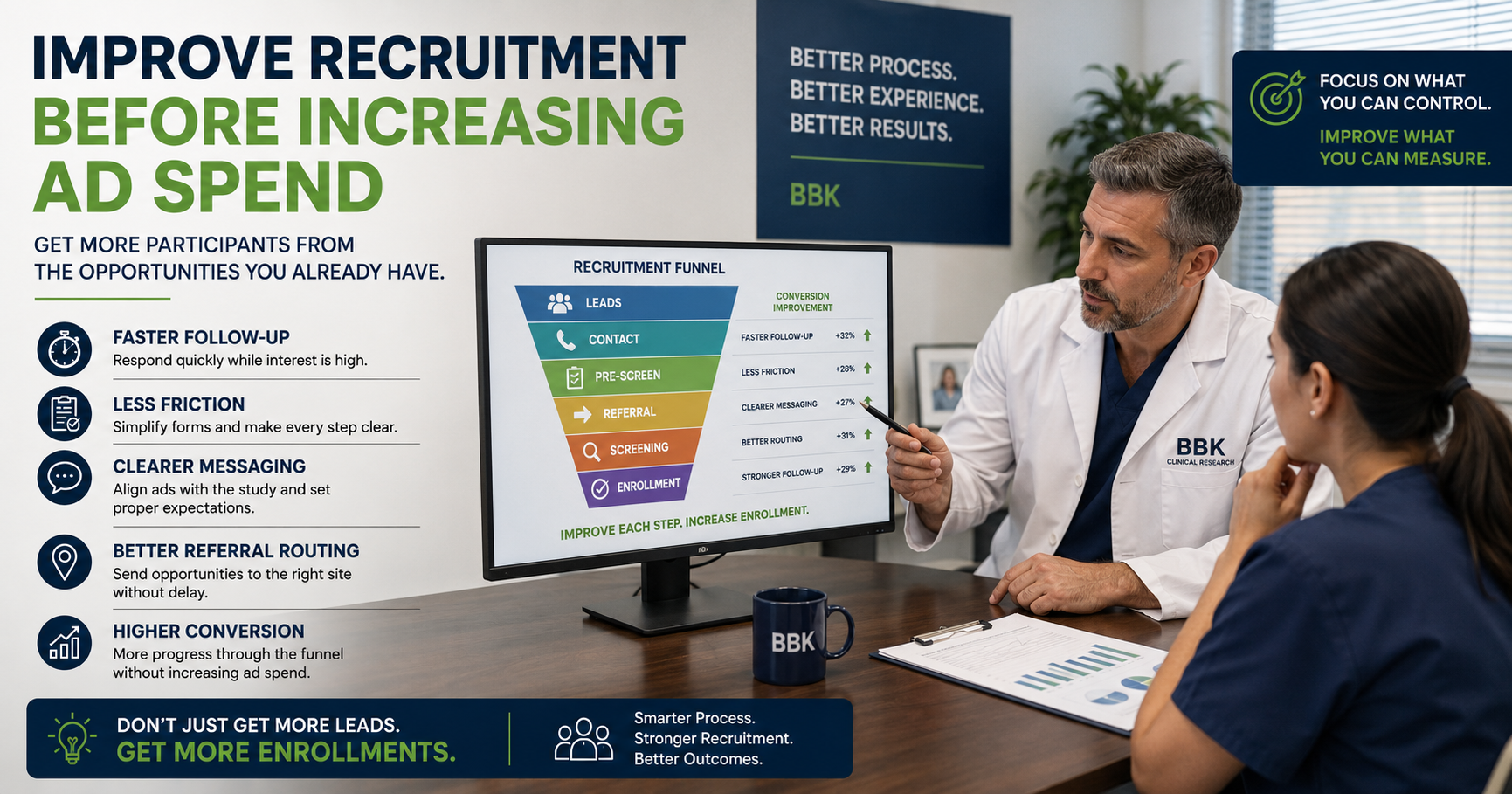
When a clinical trial is behind its recruitment target, one of the most common reactions is simple: increase the advertising budget.
Sometimes that is necessary. But not always.
A Research Site may already be generating enough interest and still be losing potential participants somewhere between the advertisement, preliminary pre-screening, follow-up, referral, Site contact, and screening appointment. In that situation, buying more traffic can simply send more people into the same inefficient system.
Before increasing media spend, Research Sites should ask a different question: are we converting the recruitment opportunities we already have as effectively as possible?
That question can uncover several opportunities to improve recruitment performance without spending another dollar on advertising.
More Advertising Does Not Fix Every Recruitment Problem
Advertising has a specific role. It can create awareness, generate inquiries, reach new geographic areas, introduce potential participants to a Study, and increase the number of people entering the recruitment funnel.
What it cannot do is repair every problem that occurs afterward. A Site can have a strong campaign and still experience weak enrollment because inquiries are contacted too slowly, forms create unnecessary friction, messaging attracts the wrong expectations, preliminary pre-screening is confusing, leads are routed inefficiently, referrals sit untouched, calls come from unfamiliar numbers with no context, Site capacity is limited, or recruitment outcomes are not being tracked well enough to identify the real bottleneck.
Clinical-trial recruitment research consistently shows that recruitment difficulties arise from multiple operational and participant-level barriers rather than from one isolated factor. One recruitment optimization project identified numerous barriers and enablers within areas Sites can directly influence, reinforcing the value of examining Site processes instead of treating recruitment only as an acquisition problem.
The practical implication is straightforward: before buying more leads, improve what happens to the leads you already have.
1. Reduce the Time Between Registration and First Response
Consider the participant experience. Someone sees an advertisement while scrolling on their phone at 8:30 p.m. The Study looks relevant. They complete the form. Their interest is strongest at that moment.
If the first human contact comes two or three days later, the situation has changed. The person may forget which Study they responded to, ignore an unfamiliar phone call, assume nobody received their information, lose interest, become uncertain about participation, or respond to another opportunity. The advertising cost has already been incurred. The lost opportunity now comes from the workflow.
Research Sites should therefore examine average response time, response time by day of week, after-hours registrations, weekend registrations, number of contact attempts, and time between referral and Site outreach.
The solution does not necessarily require someone working 24 hours a day. An automated acknowledgment can immediately tell the prospective participant that their information was received, which Study or Research Site it relates to, what happens next, and when they should expect further contact. Automation should not replace appropriate human interaction, but it can prevent silence from becoming the first participant experience.
Studies of digital tools in clinical trials have found broad use of email, SMS and other communication technologies for recruitment and retention, while also emphasizing the continuing importance of human interaction, transparency and engagement.
2. Make the Recruitment Form Easier to Complete
A campaign may generate excellent click-through rates while producing fewer registrations than expected. The problem may not be the advertisement. It may be the form.
Research Sites should experience their own recruitment process as a participant would. Open the advertisement on a mobile phone. Click it. Complete the form. Then ask: does the page load quickly? Is the Study immediately recognizable? Is the text understandable? Are there unnecessary fields? Are questions repetitive? Is the consent or authorization language understandable? Is the next step clear? Does the form work correctly on a small screen? Does the participant know what will happen after submission?
Every unnecessary step creates another opportunity for abandonment. That does not mean pre-screening should be reduced to the point of becoming useless. It means every question should have a purpose.
A useful rule is: ask what is needed to move the recruitment process forward — not everything that could possibly be asked. Detailed protocol screening belongs at the appropriate stage of the research process. The digital entry point should be designed around clarity and progression.
3. Reconsider the Questions Used for Preliminary Pre-Screening
Pre-screening can improve recruitment efficiency. Poorly designed pre-screening can damage it. For example, a lengthy questionnaire may eliminate many people efficiently, but it may also cause potentially relevant participants to leave before completing it.
Research Sites should review questions for clarity, necessity, reading level, mobile usability, appropriate language, and whether the prospective participant understands why the information is being requested.
There is also an important operational distinction between preliminary pre-screening and formal Study eligibility. Early digital questions can help determine whether further contact appears appropriate. They should not create the impression that a person has officially qualified for the Study. This distinction protects both participant expectations and recruitment reporting.
Instead of reporting “120 qualified patients” when those people have only answered several preliminary questions, a more precise workflow might use “120 preliminary pre-screened opportunities,” followed later by “65 referred to Site,” and then “28 formally screened.” Better terminology leads to better decision-making.
4. Improve the Match Between the Advertisement and the Actual Study
Some campaigns produce large numbers of low-value inquiries because the advertising is doing exactly what it was designed to do: maximize response. That may not be what the Research Site actually needs.
An advertisement that is too broad can generate interest from people who misunderstand the age range, location, condition, type of Study, visit requirements, or basic participation expectations.
The solution is not necessarily narrower platform targeting. Sometimes the creative itself should perform more of the filtering. For example, when appropriate and approved, the advertisement may communicate the relevant condition, general age range, Study location, that this is a clinical research opportunity, whether a parent or caregiver is involved, and an accurate next step.
Clearer advertising may reduce total lead volume. That can be a good result. If fewer inquiries generate a greater proportion of relevant participant opportunities, recruitment efficiency improves. More clicks are not always the objective. Better alignment is.
5. Use Different Creative to Address Different Participant Concerns
Research Sites sometimes run one advertisement for months because it continues generating leads. But the same Study may involve audiences with different motivations and concerns.
One creative might emphasize learning about a research opportunity. Another might explain what happens after you register. Another could address participation at a local Research Site. For caregiver-driven Studies, messaging may need to speak primarily to the parent, spouse or caregiver rather than the potential participant directly.
The purpose is not simply creative variety. Different messages can help identify which concerns prevent the right audience from engaging. Digital recruitment research has shown that tools and strategies must be considered in relation to different populations, accessibility, participant attitudes and engagement — not merely raw reach.
6. Fix Communication Barriers
Sometimes a referral appears ideal on paper but disappears during contact. Communication problems are a real recruitment barrier. A U.S. clinical research project examining recruitment barriers identified issues including unreliable contact information, trust and communication, and used real-time barrier analysis to connect those problems with practical solutions.
Sites should therefore review simple questions. Does the participant recognize who is calling? An unidentified phone number can easily be mistaken for spam. Was the participant told to expect the call? A confirmation message can dramatically change the context of the same phone call. Is communication available in the participant’s preferred language? A successful Spanish-language advertisement followed by English-only outreach creates an obvious break in the participant experience, as discussed in Article No.6. Is the initial message understandable? Research terminology familiar to staff may be unfamiliar or intimidating to prospective participants. Are communication channels appropriate? Phone may be essential, but SMS or email can sometimes help establish contact before the call, where appropriate and properly consented.
Small communication improvements can recover recruitment opportunities without generating a single additional lead.
7. Improve Lead Routing
Multi-Site recruitment adds another source of inefficiency. A centralized campaign may generate a strong referral, but what happens next? Does the referral automatically reach the appropriate Site? Is routing based on ZIP code, distance, recruitment territory, Study availability, Site capacity, or manual judgment? What happens if two Sites serve the same geographic area? What happens when a Site becomes temporarily overloaded?
Poor routing can turn a potentially useful referral into a delayed response. A stronger system should make it clear who owns each recruitment opportunity and when responsibility transfers. This becomes increasingly important for CROs, SMOs and multi-location organizations because recruitment efficiency depends not only on generating candidates but on connecting them rapidly with the correct operational team.
8. Measure Why Prospective Participants Are Lost
A funnel showing that 100 people disappeared is less useful than knowing why. Research Sites should develop practical disposition categories, such as unable to contact, incorrect phone, outside age range, outside geography, condition not confirmed, declined participation, scheduling barrier, transportation concern, did not complete pre-screen, referred to Site, screening scheduled, screen failure, and enrolled.
These categories turn lost recruitment opportunities into information. Patterns can then emerge. Suppose 35% of rejected leads live outside the recruitment area — that points toward a geographic problem. Suppose many apparently relevant referrals are marked “unable to contact” — that suggests a communication problem. Suppose people complete pre-screening but decline immediately after hearing about required visits — that may suggest participant expectations should be addressed earlier.
Without disposition data, all three problems may simply appear as low conversion.
9. Review the Site’s Own Capacity
Sometimes recruitment needs to slow down rather than accelerate. If a Site receives more referrals than staff can process, increasing advertising can make performance worse. Potential symptoms include long callback times, referrals accumulating in spreadsheets, incomplete documentation, missed screening appointments, duplicated calls, and inconsistent participant communication.
Clinical-trial recruitment studies have identified staff time, organizational support, workflow and Site-level operational factors as meaningful recruitment barriers. Research Sites therefore need to understand how many new recruitment opportunities they can realistically process each day. That capacity should influence campaign volume. A recruitment campaign should support Site operations, not overwhelm them.
10. Optimize Toward Referrals and Screening, Not Just CPL
Once the workflow improves, marketing optimization should move deeper into the funnel. Imagine two geographic areas. Area A generates 100 leads at $20 CPL, producing 8 referrals and 3 screenings. Area B generates 60 leads at $30 CPL, producing 22 referrals and 12 screenings.
If the campaign is optimized only for CPL, Area A appears better. If the Site examines downstream recruitment, Area B may deserve additional budget. The numbers are illustrative, but the principle is important. Sites should progressively connect advertising spend, leads, pre-screen, referral, Site screening and enrollment.
Not every organization will have perfect attribution immediately. That is acceptable. Even partial downstream data can improve decision-making. Research on digital recruitment has noted that relatively few studies measure efficiency such as cost per recruited participant, reinforcing the need for recruitment organizations to look beyond simple acquisition metrics where possible.
Find the Bottleneck Before Increasing the Budget
Before adding another $1,000, $5,000 or $10,000 to recruitment advertising, a Research Site should examine where the current system loses participants.
The answer may be that the Site needs more reach. If so, additional advertising may be appropriate. But the answer could also be that the Site needs faster follow-up, a shorter form, better Spanish communication, clearer advertising, more accurate routing, a better understanding of why referrals disappear, or additional Site capacity.
Those improvements can increase recruitment output while the media budget remains unchanged. The broader lesson is simple: participant recruitment efficiency is not determined by advertising spend alone. It is determined by how effectively a Research Site converts interest into appropriate participant progression.
Before buying more traffic, improve the road that traffic is already traveling. That is often where the greatest recruitment opportunity exists.
Related Reading
- Why Research Sites Should Stop Measuring Recruitment Success by Leads Alone
- The Hidden Cost of Slow Follow-Up in Clinical Research Recruitment
- The Metrics That Actually Matter in Clinical Trial Recruitment Campaigns
- Why Participant Experience Matters Before the First Research Site Call
- Human Follow-Up vs Automation in Clinical Research Recruitment
Frequently Asked Questions
Can a Research Site increase recruitment without increasing advertising spend?
Yes. Depending on the bottleneck, improvements to response time, recruitment forms, preliminary pre-screening, messaging, communication, referral routing and Site workflow can improve conversion without increasing media spend.
Should a Site stop advertising while optimizing its recruitment funnel?
Not necessarily. Advertising and funnel optimization can occur simultaneously. The objective is to identify whether insufficient lead volume is actually the primary constraint before automatically increasing budget.
What recruitment metric should Sites review first?
There is no universal first metric, but connecting lead volume with contact rate, pre-screen completion, referral rate and Site screening can quickly reveal where meaningful drop-off is occurring.
Can fewer leads produce better recruitment results?
Yes. A campaign generating fewer but more relevant inquiries can create more referrals and screenings than a high-volume campaign with poor downstream conversion.
How does follow-up affect clinical trial recruitment?
Follow-up determines what happens after initial interest. Slow, unclear or inconsistent communication can cause potentially relevant participants to disengage before Site screening.